NSW LearnerNSW DKT practice
Get NSW Learner free

Practise for the NSW driver knowledge test

Road Safety

Night driving, headlights and bad weather in NSW

In the test. Night and weather questions belong to road safety on the DKT. They check headlight and fog light rules, then ask how to handle rain, aquaplaning, floods, glare, wind and loose surfaces.

Quick answer

When do you have to dip your high beam in NSW?

Switch from high beam to low beam once a vehicle ahead of you, or one coming the other way, is less than 200 metres away. You may flick briefly to high beam just before overtaking. Headlights must be on at night and whenever the daylight is so poor you cannot make out a person 100 metres away, and your lights must never dazzle other road users.

The short version

  • Headlights on at night and whenever you cannot see a person 100 metres away
  • Dip high beam within 200 metres of any vehicle ahead or oncoming
  • Low beam in fog, never high beam
  • Four seconds or more behind the car ahead in the wet
  • Never drive into floodwater

Headlight and high beam rules

Lights help you see, and just as importantly they help others see you.

  • Headlights go on at night, and in daytime too whenever it is so dull that a person 100 metres off cannot be seen: at dusk or dawn, under heavy cloud or in a storm. Low beam is the setting for those times.
  • Dip to low beam within 200 metres of a vehicle in front or an oncoming vehicle.
  • High beam is allowed on any road, with or without street lights, as long as no vehicle is within 200 metres.
  • A short flash from low to high beam just before you overtake is allowed.
  • No light may be used in a way that dazzles another driver or a pedestrian.
  • Fog lights are reserved for fog, mist and other conditions that cut how far you can see. Switch them off when the view clears.
  • Parked at night on a road with no street lights? Your parking lights must be on. For a quick stop after dark, leave the car where other drivers can clearly see it, or put the parking lights on. Headlights stay off while parked, except during a passenger drop off or pick up.

High beam dazzles through mirrors as well as windscreens, so the 200 metre rule covers cars ahead of you too.
Driving in the dark

At night hazards appear late, so your speed has to match what your lights show.

  • Drive at a speed that lets you stop within the distance your headlights light up.
  • Low beam reaches only a short way, so you can be too fast at night even under the limit.
  • Expect kangaroos and other wildlife on country roads, most of all around dawn and dusk.
  • Dazzled by oncoming lights? Ease off and fix your eyes on the left edge line until they pass. Glare from behind? Switch the rear view mirror to its night position.
  • Keep the windscreen clean inside and out, because smears scatter light and add glare.
  • Brake before a bend, not halfway through it.

Rain, aquaplaning and floodwater

Water takes away grip and visibility at the same time.

  • Slow down, turn your headlights on and stretch your gap to four seconds or more.
  • The first rain after a dry spell lifts oil and dust into a slick film. Any wet surface, morning dew included, stretches the time and distance you need to stop.
  • Brake firmly but smoothly. Stamping on the pedal in the wet can lock the wheels and send the car into a skid.
  • Aquaplaning means the tyres are skimming on a film of water. Lift off the accelerator, keep the wheel straight and do not brake hard.
  • Worn tyres clear water poorly, so aquaplaning becomes far more likely.
  • Never drive into floodwater when you cannot see the road surface. Turn around.
  • After a puddle or a flooded dip, test your brakes gently.

Floodwater can be deeper or faster than it looks, and it can carry a car away.

Fog, glare, wind and smoke

Each kind of poor visibility has its own fix.

  • Fog: slow down and use low beam, plus fog lights if fitted, never high beam, which bounces back at you. No fog lights? In thick fog you may switch on your hazard lights so others can spot you.
  • Low sun: sun visor, sunglasses and a slower speed.
  • Strong wind: slow down and grip the wheel firmly, especially when passing trucks.
  • Dust or smoke: headlights on and speed down. If the view goes, get right off the road.
  • Fogged windscreen: run the demister or air conditioning until the glass is clear, then continue.

Gravel and ice

Loose or frozen surfaces reward gentle driving.

  • On gravel, lower your speed, allow more distance to stop and avoid sudden steering.
  • In alpine areas on frosty mornings, black ice hides on shaded parts of the road, on bridges and in hollows.
  • Keep every input smooth: steering, braking and accelerating.

Try this

Worked examples to think through

Picture the situation, decide what you would do, then open the answer.

1Try this

Driving on high beam along an unlit country road, you notice headlights glowing over the top of a hill ahead. At what point must you switch to low beam?

Show the answer

Once that car is within 200 metres, though dipping sooner is better. If its lights dazzle you, slow down and keep your eyes on the left edge of the road (rule 218).

2Try this

A downpour hits while you are on the motorway, and spray thrown up by trucks blots out the road in front. How do you respond?

Show the answer

Headlights on, speed down and a gap of four seconds or more. If you feel the tyres lift and float, come off the accelerator and keep the wheel straight instead of braking hard.

Practise it

Three night driving and adverse conditions questions to try

Real questions from the 67 in the NSW Learner bank for this topic, three options each like the test. Pick one to see the answer, the reason and the rule.

Question 1 of 3 Road Safety

When must your headlights be on?

Right.Not quite. The answer is A.

Headlights must be on during darkness, which includes dull daytime conditions where someone in dark clothes cannot be seen 100 metres away.

Source: Road Rules 2014 (NSW) rule 215-1

Question 2 of 3 Road Safety

A car is coming towards you at night and you are on high beam. When must you dip?

Right.Not quite. The answer is B.

Within 200 metres of an oncoming vehicle you must switch to low beam.

Source: Road Rules 2014 (NSW) rule 218

Question 3 of 3 Road Safety

You see this sign while driving at night. When should you slow down?

Right.Not quite. The answer is A.

Braking before a curve keeps the car balanced as you steer through it.

Source: Safe driving practice

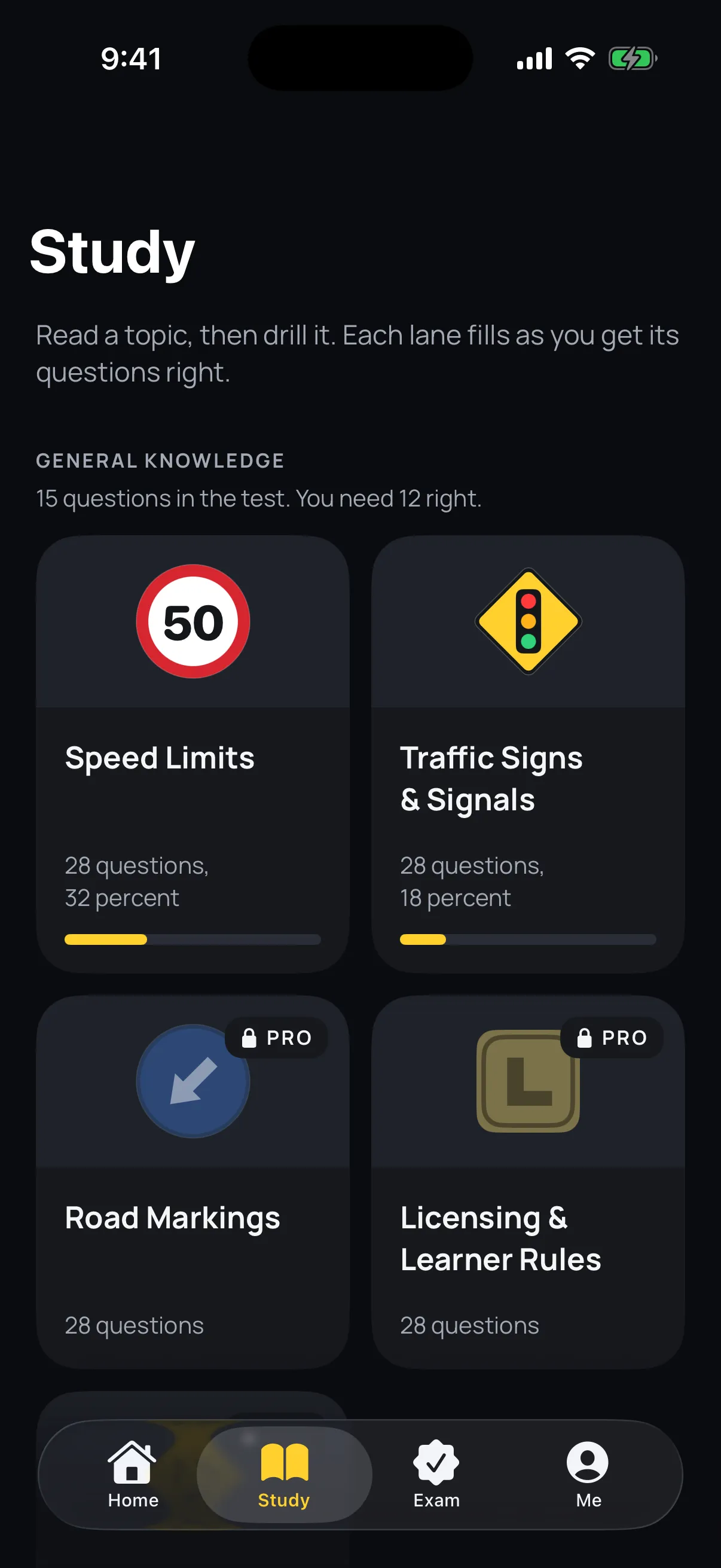
The NSW Learner Study tab with topic tiles, each with its drawn sign and a lane showing progress

Practise this topic in the app

Drill night driving and adverse conditions until it is automatic

In NSW Learner this topic has its own lesson and a drill of 67 questions. Questions you miss come back sooner, the lane on the tile fills as you get them right, and the mock exam mixes it in with everything else in the test's layout.

Common questions

When can you use fog lights in NSW?
Only when fog, mist or a similar condition is limiting what you can see. Turn them off as soon as visibility returns.
Should you use high beam in fog?
No. High beam reflects off fog and makes it harder to see, so use low beam and fog lights if fitted.
What should you do if you start aquaplaning?
Ease off the accelerator, hold the steering straight and avoid braking hard until the tyres grip again.
Do you need headlights on during the day in a storm?
Yes, if the light is so dull that a person 100 metres away cannot be seen. The law treats that as darkness.
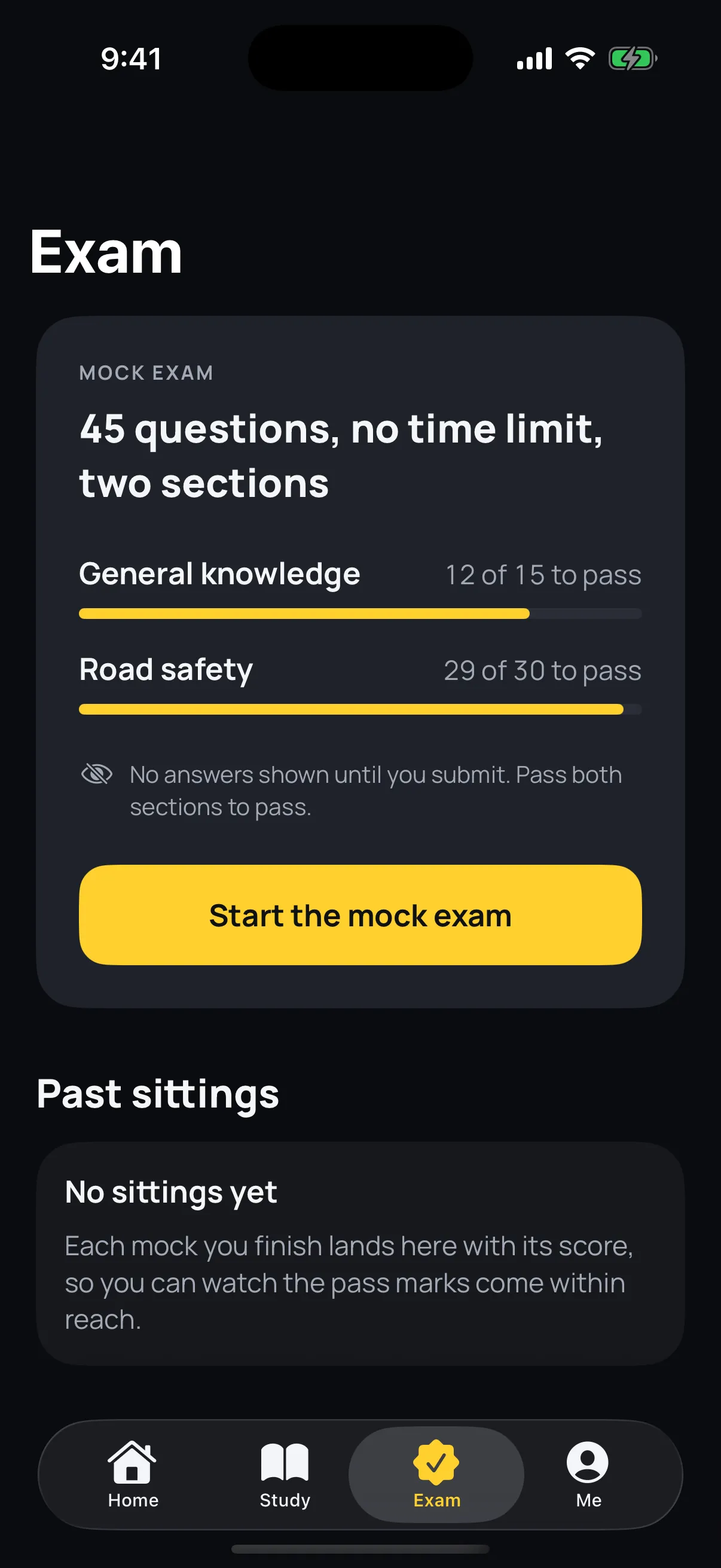
NSW Learner mock exam screen: 45 questions, no time limit, two sections with their pass marks
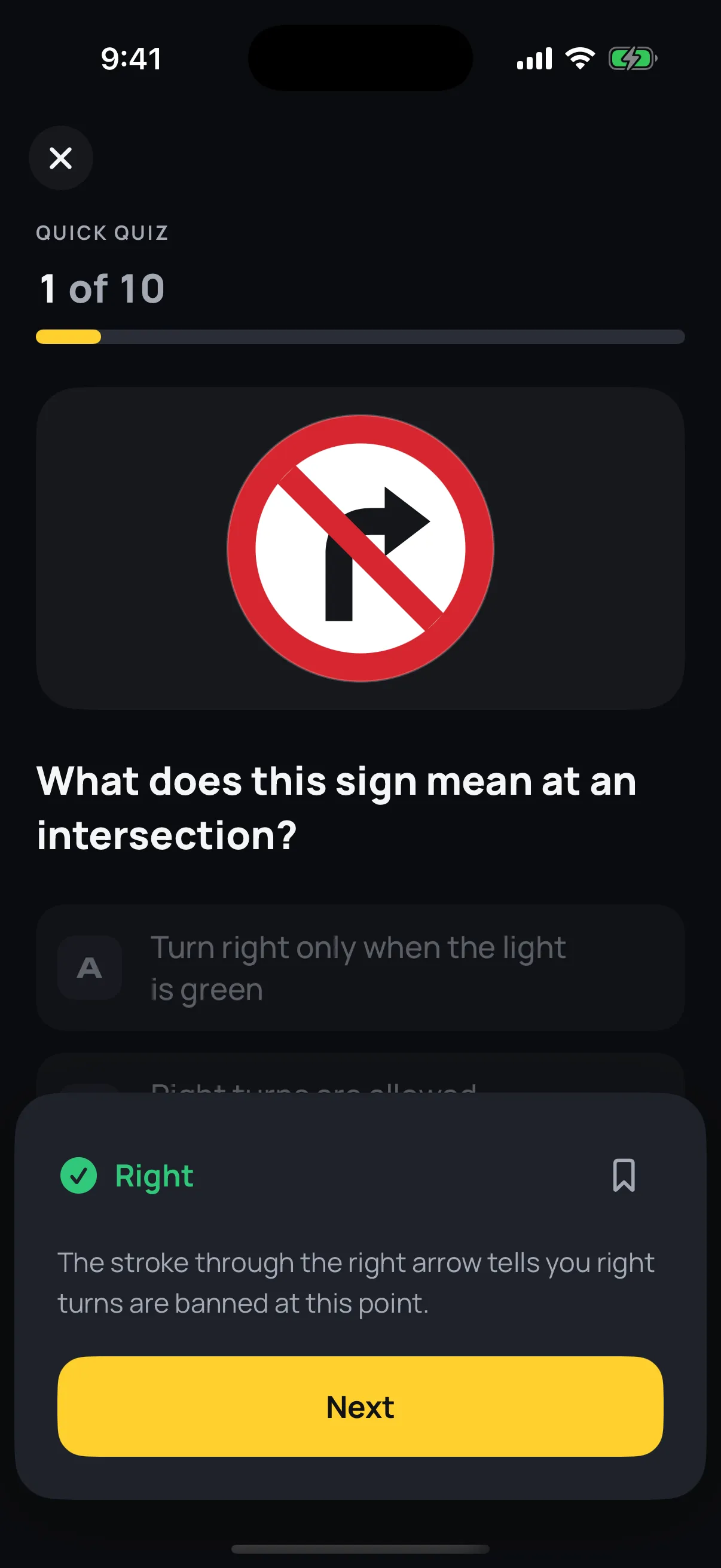
A practice question in NSW Learner answered correctly, with the explanation card
LP

Your L plate turns green when you would pass

NSW Learner is the practice app behind this site. Short lessons for every topic, drills that bring back what you got wrong, and a mock exam in the test's layout. It reads your recent scores and tells you honestly when you are ready.

  • Free one full mock exam, and the speed limits and traffic signs and signals topics with their lessons, drills and 179 questions
  • Pro all nineteen topics, all 1,177 questions and unlimited mock exams, one-time purchase, no subscription, no ads
  • Private no account, works offline, your progress stays on your phone

Independent study app. Not affiliated with Transport for NSW or Service NSW.