Road signs library
NSW road signs, every one explained
Quick answer
Which road signs do you need to know for the NSW DKT?
You need to read regulatory signs, which you must obey, like stop, give way, speed limits, lanes and no stopping; warning signs, the yellow diamonds for curves, crossings, animals and roadworks; railway crossings; and traffic lights and road markings. The test also shows top-down scenes and driver's views and asks who goes first. This library draws and explains all 159 of them.
Regulatory signs 41
Instructions you must obey: stop, give way, speed limits, turns, lanes, parking and stopping.
Stop and give way
- Stop signCome to a complete stop at the line, then give way before you move.
- Give way signSlow down and let traffic on the road you are entering go first, stopping if needed.
- Give way to buses signWhen the bus ahead signals to leave its stop, let it pull out in front of you.
- Stop sign for when the lights are outWhen the lights are off or flashing yellow, stop here, then give way as at a stop sign.
- Roundabout give way signGive way to every vehicle already travelling around the roundabout.
- Crossing supervisor's STOP signWhen the supervisor holds this up, stop and stay stopped until they lower it.
- Stop here on red signal signWhen the temporary lights show red, stop at this sign and wait for green.
Turns and direction
- No entry signDo not drive past this sign into the road beyond it.
- Keep left signPass to the left of the sign and the island it stands on.
- No U-turn signYou must not make a U-turn where this sign applies.
- No left turn signTurning left is banned at this point.
- No right turn signTurning right is banned at this point.
- One way signAll traffic on this road travels in the direction of the arrow.
- Right lane must turn right signIf you are in the right lane here, you turn right at the intersection.
- Two way traffic signFrom here traffic comes towards you as well, so keep to the left side.
- Left turn only signEveryone at this point must turn left, the way the arrow shows.
- Left turn on red permitted after stopping signAt a red light here, stop completely, then you may turn left when it is safe.
- U-turn permitted signYou may make a U-turn here, as long as it is safe.
- Do not overtake turning vehicle signStay behind a long vehicle with this sign while it turns.
Speed
- 40 km/h speed limit sign40 km/h is the most you may drive from this sign on.
- 50 km/h speed limit sign50 km/h is the limit, and the same number applies in built-up areas with no sign.
- 60 km/h speed limit sign60 km/h is the highest speed you may drive past this sign.
- 80 km/h speed limit sign80 km/h is the top speed allowed from this sign, for every licence type.
- 100 km/h speed limit sign100 km/h for full licence and P2 drivers; learners and P1 drivers stay at 90.
- 40 km/h school zone sign40 km/h past the school during the times shown, on school days.
- Local traffic area 40 signEvery street past this sign is 40 km/h, and people walking and riding share it.
- School bus flashing 40 signWhile the lights flash, pass the bus no faster than 40 km/h.
- 70 km/h speed limit signDrive no faster than 70 km/h from this sign until another limit appears.
Parking and stopping
- No parking signStop for 2 minutes at most to drop off or pick up, staying within 3 metres of the car.
- No stopping signDo not stop at all, even for a moment, where this sign applies.
- Parking signParking is allowed here, for the time limit and hours the sign shows.
- Taxi zone signKeep your own car out of this kerb space; it is for taxis only.
- Clearway signDuring the hours on the sign, do not stop at the kerb at all.
- Disability parking signPark here only if your vehicle displays a valid mobility parking permit.
Lanes and zones
- Bus lane signKeep out of this lane in a car, except briefly to turn or get on and off the road.
- Shared zone sign, 10 km/hDrive at the number shown, usually 10 km/h, and give way to every pedestrian.
- Tram lane signKeep your car out of the tram lane except where the road rules let you in.
- T2 transit lane signUse this lane during its hours only with at least two people on board, the driver included.
- T3 transit lane signUse this lane during its hours only with three or more people aboard.
- Motorway signYou are now on a motorway, so no U-turns, no reversing and no stopping except in an emergency.
- Keep left unless overtaking signDrive in the left lane and use the right lane only to pass.
Warning signs 36
Yellow diamonds and plates that tell you what is ahead, so you can slow down and get ready.
Animals and people
- Children crossing warning signChildren may be crossing ahead, so slow down and be ready to stop.
- Pedestrian crossing ahead warning signA pedestrian crossing is ahead, so slow and be ready to give way.
- Kangaroos ahead warning signKangaroos often cross here, especially around dawn, dusk and at night.
- Stock crossing warning signFarm animals may be herded across the road ahead.
- Cattle ahead warning signCattle or other stock may be on the road or wander onto it.
- Bicycles ahead warning signExpect cyclists on the road ahead and give them room.
- Pedestrians ahead warning signPeople may be walking on or across the road ahead, so slow down.
- Stock on the road warning sign with distanceCattle or sheep may be on the road for the distance shown, so slow down and be ready to stop.
- Kangaroo warning sign with NEXT 30 km plateWatch for kangaroos on the road for the whole 30 km shown on the plate.
Surface and hazards
- Slippery road warning signThe road surface ahead may give poor grip, especially in the wet.
- Road hump warning signA raised hump crosses the road ahead, so slow down before it.
- Dip warning signA sudden drop in the road is ahead, so slow down before you reach it.
- Trucks ahead warning signTrucks may pull onto or cross the road ahead, so slow down and watch for them.
- Slippery when wet warning signGrip is poor here in the wet, so slow down and brake and steer gently.
Curves and hills
- Steep descent warning signA steep downhill section is ahead, so choose a lower gear before it.
- Sharp left curve warning signA sharp curve to the left is ahead, so slow down before it.
- Sharp right curve warning signA sharp curve to the right is ahead.
- Winding road warning signA series of bends is ahead, so keep your speed down for the whole stretch.
- Crest warning signYou cannot see over the hill ahead, so slow down and keep left.
- Curve warning sign with advisory speedTake the bend at no more than the speed on the plate, and slower in the wet.
- Hairpin bend warning signA very tight bend to the right is ahead, so slow down early and keep left.
Road layout
- Road narrows warning signThe road gets narrower ahead, so slow down and keep left.
- T-intersection ahead warning signYour road ends at a T-intersection ahead, so you must turn left or right.
- Crossroad ahead warning signA crossroad is ahead, where traffic can come from the left, the right or straight on.
- Side road ahead warning signA side road joins ahead, on the side the branch shows.
- Divided road warning signA divided road begins ahead, with a median separating the two directions.
- Road divides warning signThe road splits around an island ahead, so keep to the left.
- Roundabout ahead warning signA roundabout is ahead, and traffic already in it has priority.
- Narrow bridge warning signThe bridge ahead is narrow, so slow down and keep well to the left.
- Divided road ends warning signThe median ends ahead, so keep left and expect oncoming traffic beside you.
Signals and crossings
Stop and give way
Roadworks
- Workers ahead signPeople are working on the road ahead, so slow down and be ready to stop.
- Traffic controller ahead signA person is directing traffic ahead, so slow down and do exactly what they show.
- Lane ends, merge signYour lane is ending, so merge into a gap and give way to the lane that continues.
Railway crossings 7
Crossbucks, flashing lights and the warnings before them. A train always goes first.
Signals and crossings
Crossings with signs
Crossings with lights
Signals and markings 11
Traffic lights and arrows, bus and tram lights, pedestrian signals and the paint on the road.
Signals for buses and trams
Traffic lights
Turn arrows
Pedestrian signals
Road scenes 52
Top-down drawings of the give way, lane, overtaking and parking situations the test asks about.
Intersection scenes
- Giving way at a T-intersectionThe car on the road that ends gives way to traffic on the road that continues.
- Give way to the right at a crossroadAt a crossroad with no signs or lights, give way to the vehicle on your right.
- Signalling left as you leave a roundaboutSignal left as you leave a roundabout, if it is practical to do so.
- Turning right across oncoming trafficWhen you turn right, oncoming vehicles going straight or turning left go first.
- Turning right from a one-way streetOn a one-way road, start a right turn from the far right side.
- Choosing a lane at a two-lane roundaboutLeft lane for left, right lane for right, either for straight, and leave in the lane you entered.
- Stopped at a stop sign, give way to all three carsStop at the line, then let every car on the crossing road and the oncoming car go first.
- Give way signs on both sides: the right turner waitsWhen both approaches have give way signs, the car turning right waits for the oncoming car going straight.
- Two cars turning right pass in front of each otherWhen an oncoming car is also turning right, turn in front of it and keep your turn tight.
- Green light, full road ahead: wait behind the lineEven on green, stay behind the line until there is room for your whole car past the intersection.
- Turning right from one of two right turn lanesSignal right, stay in your own curve, and finish in the lane that matches the one you turned from.
- A building on the corner hides a car in the side streetWhere a corner blocks your view, slow down and be ready for traffic to appear from the side street.
- Both give way signs: you turn right, they turn leftWhen you and the car facing you both have give way signs, your right turn waits for its left turn.
- Stopping for a crossing, then again at the stop lineStopping for a pedestrian does not count; stop again at the stop line before you enter the intersection.
- A give way sign where a street meets the road at an angleAt a give way sign, let traffic on the road you are joining pass before you pull in.
- Both stop signs: you turn right, they turn leftWith stop signs both ways, both cars stop, then you give way to the oncoming car turning left before turning right.
Parking scenes
- No stopping near an intersectionKeep at least 10 metres clear of an intersection without lights when you stop.
- No stopping near a pedestrian crossingNo stopping 20 metres before a pedestrian crossing and 10 metres after it.
- Double parking beside a parked car is bannedNever stop next to a car parked at the kerb, even briefly; find a legal spot instead.
- No stopping 20 metres before a bus stop and 10 afterKeep 20 metres clear before a bus stop sign and 10 metres clear after it.
- Parallel, angle and front-to-kerb parkingPark parallel to the kerb unless signs or markings show another angle, then use that angle.
- Reversing out of a parking space only as far as you needBack out just far enough to turn into the nearest lane, and no further.
- Doing a head check before pulling out from the kerbSignal, check your mirrors, then look over your shoulder as the very last check before you move.
Road markings
- Crossing a broken centre line to overtake or turnYou may cross a single broken centre line to overtake or to turn, once the way ahead is clear.
- A continuous centre line: turn across it, never overtakeNever cross a single continuous centre line to overtake, though you may cross it to turn in or out of a side street.
- Double continuous centre lines: in and out onlyCross double continuous lines only to get into or out of a road or driveway, never to pass.
- Crossing a white edge line to turn leftYou may cross the white edge line to turn into or out of a side street.
- Broken line nearer you beside a continuous lineWhere the broken line of a pair is the one closer to you, you may cross to overtake if the way ahead is clear.
- Continuous line nearer you beside a broken lineIf the continuous line of the pair is on your side, do not cross to overtake, though you may cross to turn right into a side road.
- A continuous line between two lanes going your wayStay in your lane while a continuous line separates it from the next one.
Lane and overtaking scenes
- Two lanes merge with no line: the car ahead goes firstAt a merge with no lane lines, whichever vehicle is in front goes first.
- A painted median turning lane shared by both directionsUse the centre turning lane to wait for a right turn, ready for oncoming drivers using it too.
- Passing on the left of a car turning rightYou may pass a car that is turning right on its left, never on its right.
- Changing lanes across a broken lineAcross a broken line you may change lanes, but only into a gap, giving way to the cars already there.
- Your marked lane ends and you merge behindWhen your lane ends, the car in the lane that carries on goes first, so merge in behind it.
- A car that has passed you moves back in aheadWhile you are being overtaken, keep left, hold or lower your speed, and give the passing car room to return.
- Moving back left after passing on a fast roadOn a road over 80 km/h, return to the left once you have finished overtaking.
- Staying behind a long vehicle that is turningStay behind a long vehicle that is turning, and never pass on the side it is turning towards.
- Dropping back when the car ahead signals rightIf the car you are passing signals right, check your mirror and drop back in behind it.
Emergency vehicles
- An ambulance crossing on your green lightGive way to an ambulance with its lights and siren on, even when your light is green.
- An emergency vehicle comes up behind youWhen a siren or flashing lights come up behind, ease over to the left once it is safe and let it pass.
- A fire engine behind you while you wait to turn rightEven on a green light, an emergency vehicle with a siren or flashing lights goes before you.
People on the road
- A pedestrian steps off the refuge into your laneIf someone steps off a refuge into your path, slow down and give way to them.
- Turning and giving way to people crossingWhichever way you turn, let people crossing the road you are entering finish first.
- The minimum gap when passing a cyclistLeave at least 1 metre when passing a bike on roads up to 60 km/h, and at least 1.5 metres above that.
Safety and crashes
- Setting your side mirror: mostly road, a sliver of carAngle each side mirror so it shows mostly road, with just the edge of your own car.
- A three second gap, counted from a roadside postStay at least three seconds behind the car ahead, and stretch it to four or more in the wet or dark.
- Back seat passengers must be belted tooEvery passenger wears a fastened belt or sits in a child restraint, back seat included.
- Two cars have crashed in the middle of a crossroadStop, make the scene safe, help anyone hurt and exchange your details.
- A child restraint's top tether on the anchor pointClip the top tether strap to the car's own child restraint anchor point, as the maker's instructions say.
Trams and light rail
Driver's views 12
What you see through the windscreen, or from the kerb: night, rain, gravel, hills and people on the road.
Parking scenes
Night and weather
- High beam on a dark road with nobody within 200 mUse high beam while nobody is within 200 metres, and dip it as soon as a vehicle comes that close.
- A quiet street at night for your first night drivesBegin night practice on quiet, familiar streets, then build up to busier and darker roads.
- Heavy rain and spray on an 80 km/h roadIn rain, drive below the posted limit and stretch your gap to four seconds or more.
Road conditions
People on the road
- A child at the kerb between parked carsDriving past parked cars, slow down and leave room to stop for a child stepping out.
- An older walker still crossing as your light turns greenWait for a slow walker to reach the footpath, even when your light is green.
- People crossing a city street away from a crossingGive way to anyone crossing in front of you if there is any chance of hitting them, crossing or not.
Common questions
- What are the three kinds of road signs in NSW?
- Regulatory signs give instructions you must follow, such as stop, give way and speed limits. Warning signs, usually yellow diamonds, tell you about a hazard ahead. Guide and information signs show directions and services, and the DKT asks mostly about the first two.
- Do warning signs have to be obeyed?
- A warning sign does not set a rule by itself. It tells you what is coming so you can slow down and drive to suit, and the road rules still decide what you must do when you get there.
- Why are these signs drawn and not photographed?
- All 159 drawings on this site are made by NSW Learner in its own vector geometry, the same drawings the app uses, so they are clear at any size and in dark mode. They follow the standard shapes and colours you will see on NSW roads.
Your L plate turns green when you would pass
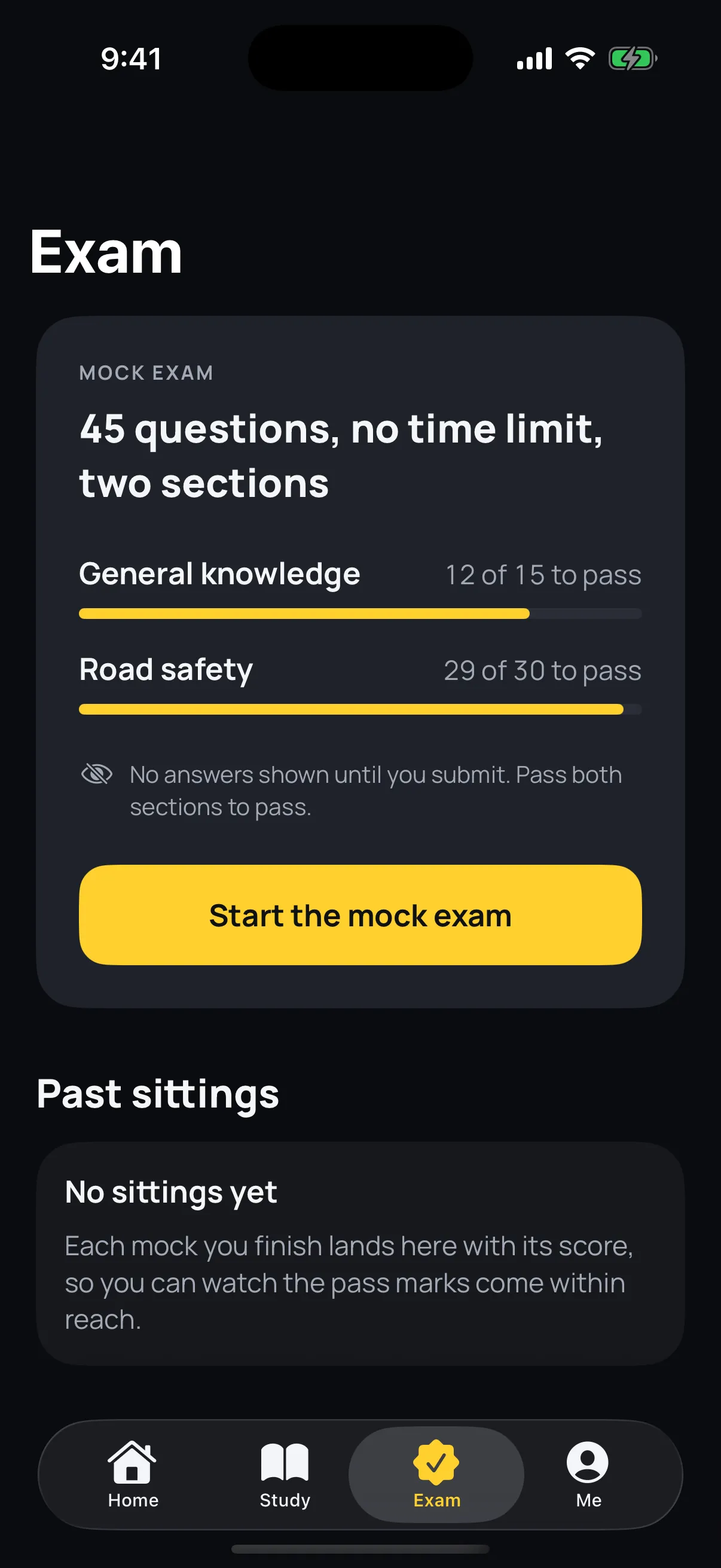
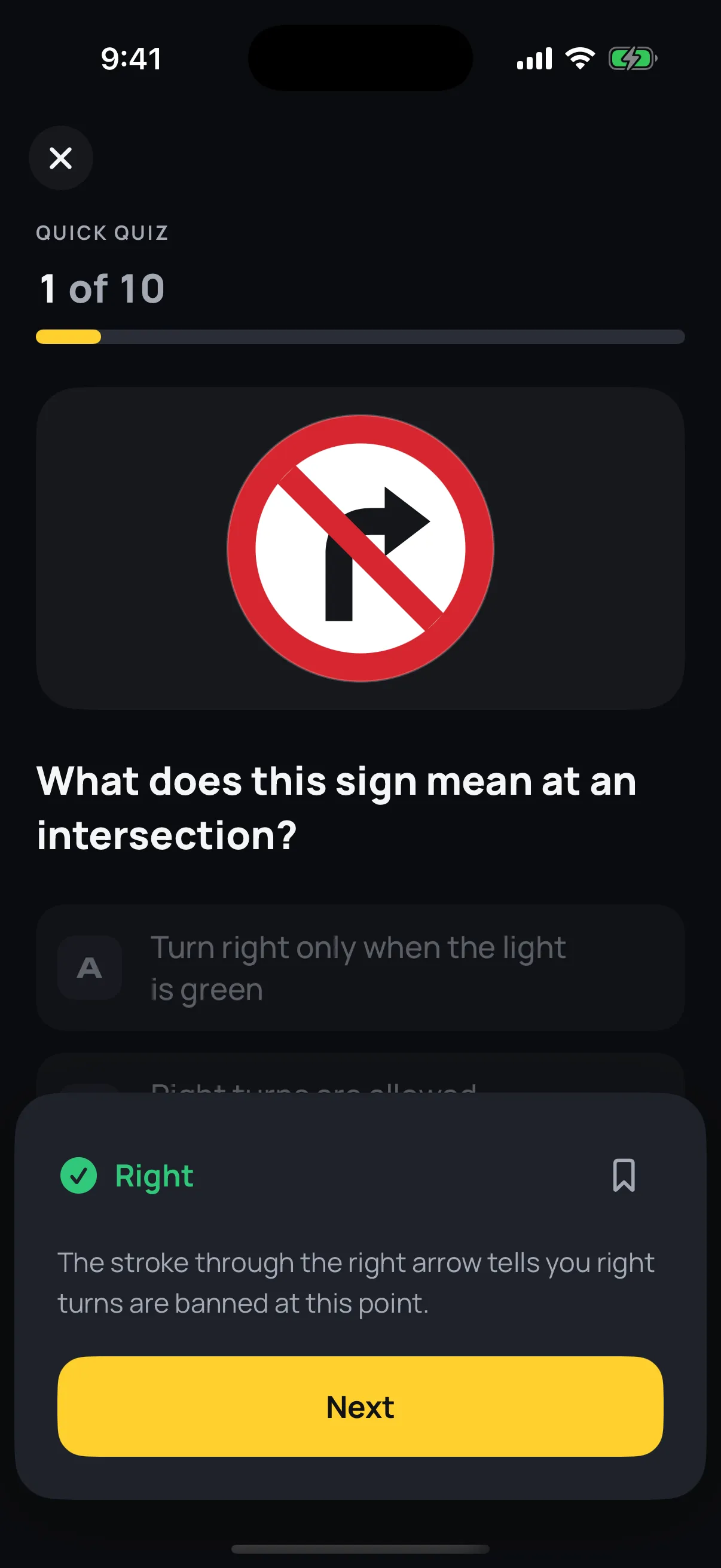
NSW Learner is the practice app behind this site. Short lessons for every topic, drills that bring back what you got wrong, and a mock exam in the test's layout. It reads your recent scores and tells you honestly when you are ready.
- Free one full mock exam, and the speed limits and traffic signs and signals topics with their lessons, drills and 179 questions
- Pro all nineteen topics, all 1,177 questions and unlimited mock exams, one-time purchase, no subscription, no ads
- Private no account, works offline, your progress stays on your phone
Independent study app. Not affiliated with Transport for NSW or Service NSW.