NSW LearnerNSW DKT practice
Get NSW Learner free

Practise for the NSW driver knowledge test

Road Safety

Overtaking and changing lanes in NSW

In the test. In the road safety section of the DKT, overtaking questions ask where passing is banned, how much room a cyclist needs, and what to do when someone overtakes you.

Quick answer

When is it legal to overtake on the left in NSW?

Overtaking on the left is legal in NSW in three cases: on a multi-lane road, past a vehicle signalling to turn right or make a U-turn, and past a stationary vehicle, each time only when safe. On a road with one lane each way, that means room on its left within the lane. Otherwise you overtake on the right, with a clear view ahead and without speeding.

The short version

  • Only overtake with a clear view and room to finish
  • The speed limit does not lift while you pass
  • Cyclists get 1 metre in 60 km/h zones or slower, 1.5 metres on faster roads
  • A car halted at a pedestrian crossing must never be passed
  • When someone overtakes you, keep left and hold your speed

Before you pull out to pass

A safe pass is decided before you move, not halfway through it.

  • Make sure you can see enough empty road to finish, and that nothing is about to emerge from a side street.
  • Hills and blind curves hide oncoming cars, so never start a pass approaching one.
  • Centre lines ahead turning continuous before you could finish? Do not start. Already out when you see them change? Ease back in behind.
  • The quicker the vehicle you want to pass, the more time and road the move eats up. Any doubt about the room means waiting for a longer clear stretch.
  • Check your mirrors, then do a head check over your shoulder for the blind spot.
  • Signal for long enough to give others fair warning, and if the pass will need extra power, change down a gear first.
  • If an oncoming car appears sooner than expected, or the pass stops looking safe for any reason, brake early and drop back in behind.

There is no overtaking allowance. On a 100 km/h road you pass at 100 km/h or less, or you do not pass.
Places you must not overtake

Some passes are banned outright, however clear the road looks.

  • Over a solid centre line, or double lines whose solid line is nearer you, unless the pass is to give a cyclist room.
  • Where a NO OVERTAKING sign applies, including NO OVERTAKING ON BRIDGE.
  • Past a vehicle stopped at a pedestrian crossing, because someone may be crossing in front of it.
  • Past the right side of a car that is signalling a right turn. If the car you are already passing starts to indicate right, check your mirror and pull back in behind it.
  • Beside a long vehicle carrying a do not overtake turning vehicle sign, on the side it is turning towards.
  • On the shoulder beyond a continuous white edge line.

Passing on the left, obstructions and trucks

Overtaking on the left is the exception, and the test checks you know when it applies.

  • Going by on the left is fine on a road with two or more lanes your way, past a car signalling a right turn or U-turn, or past one that is stopped, provided it is safe.
  • Driving along the shoulder past slow traffic is never a way to pass.
  • A broken down truck blocking your side lets you cross the centre line to get round it, but only if you must, can clearly see oncoming traffic and it is safe.
  • Getting past a long truck uses more time and road, so wait for a longer clear stretch.
  • Can you see a truck's side mirrors? If not, its driver cannot see you.

Passing cyclists

NSW sets minimum passing distances for bicycles, and the number depends on the speed limit.

  • Speed limit 60 km/h or less: leave at least 1 metre.
  • Speed limit above 60 km/h: leave at least 1.5 metres.
  • Count the gap from the rider or bike out to the closest point of your car, side mirrors included.
  • Crossing a centre line, solid or broken, is allowed to make that gap, provided oncoming traffic is in clear view and the move is safe.

If a cyclist takes the middle of a narrow lane, hold back and wait until you can give the full gap.

Lanes, signals and being overtaken

Good lane habits make overtaking safer for everyone on the road.

  • Where no lane lines are marked, stay as close to the left side as is practical.
  • Where the limit is over 80 km/h on a multi-lane road, or a KEEP LEFT UNLESS OVERTAKING sign is posted, the right lane is only for passing, turning right, U-turns and getting around obstructions. On slower roads with no such sign, any lane is fine.
  • Every lane change gets a signal, even with nobody around, plus a mirror check and a head check. Cancel the indicator once you are across.
  • Pulling out from the kerb takes at least five seconds of signal, and any move to the right, whether turning, changing lanes, passing or pulling out, gets the right indicator.
  • A red X over a lane means it is closed to you. If the X is flashing, get out of that lane when it is safe. Where your own lane simply ends, vehicles in the lane that continues go first.
  • Return to your lane once there is clear space, such as when the overtaken car appears in your rear view mirror.
  • Someone passing you? Hold your line on the left and do not accelerate.

Try this

Worked examples to think through

Picture the situation, decide what you would do, then open the answer.

1Try this

A bike rider is ahead of you on a 50 km/h road marked with a single continuous centre line. The road is empty and you can see well into the distance. May you go past?

Show the answer

Yes, with a gap of at least 1 metre. Giving a rider the legal clearance is a reason you may cross that line, as long as your view ahead is clear and it is safe (rules 144-1 and 144-2).

2Try this

You are on a two-lane country road when the car behind pulls out to pass you. How should you drive?

Show the answer

Stay left, keep your speed steady or ease it slightly, and leave space for the car to slip back in. Accelerating while someone overtakes you is an offence (rule 145).

Practise it

Three overtaking and changing lanes questions to try

Real questions from the 63 in the NSW Learner bank for this topic, three options each like the test. Pick one to see the answer, the reason and the rule.

Question 1 of 3 Road Safety

You pass a cyclist on a road with an 80 km/h limit. What is the minimum gap you must leave?

Right.Not quite. The answer is C.

Above 60 km/h the minimum passing gap rises to 1.5 metres.

Source: Road Rules 2014 (NSW) rule 144-1

Question 2 of 3 Road Safety

A broken down truck blocks your side of a road with a continuous centre line. Can you go around it?

Right.Not quite. The answer is C.

You may cross a dividing line to get around an obstruction, but only when it is necessary and reasonable, you have a clear view and you can do it safely.

Source: Road Rules 2014 (NSW) rule 139

Question 3 of 3 Road Safety

On a road with one lane each way, the car ahead has stopped and is signalling right to turn. There is room on its left within the lane. Can you pass on the left?

Right.Not quite. The answer is B.

You may pass a vehicle on its left when it is turning right and signalling, as long as it is safe.

Source: Road Rules 2014 (NSW) rule 141

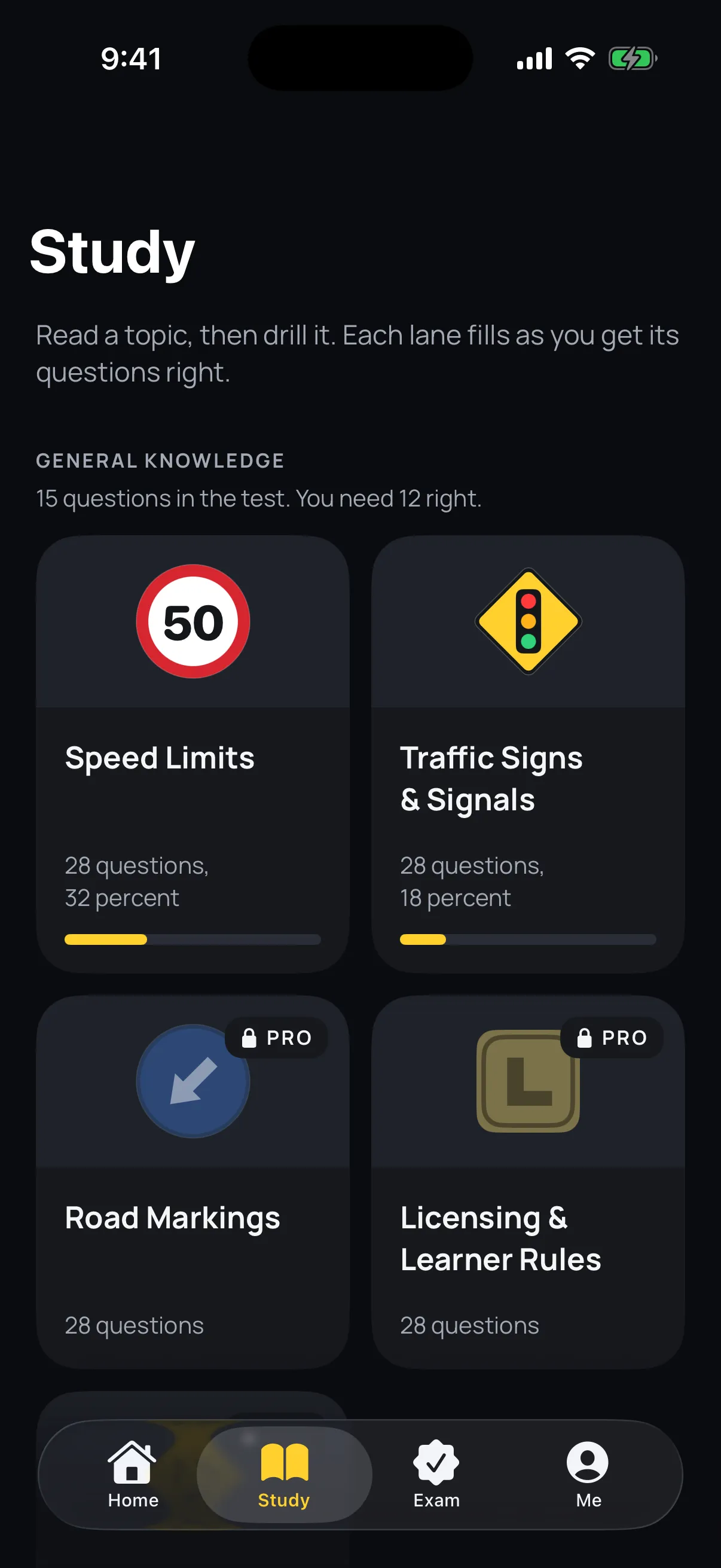
The NSW Learner Study tab with topic tiles, each with its drawn sign and a lane showing progress

Practise this topic in the app

Drill overtaking and changing lanes until it is automatic

In NSW Learner this topic has its own lesson and a drill of 63 questions. Questions you miss come back sooner, the lane on the tile fills as you get them right, and the mock exam mixes it in with everything else in the test's layout.

Common questions

How much room do you give a cyclist in NSW?
A minimum of 1 metre on roads limited to 60 km/h or less, rising to 1.5 metres on faster roads.
Can you speed to overtake in NSW?
No. Overtaking gives no extra speed, so if passing would mean going over the limit, stay behind.
How long do you indicate before pulling out from the kerb?
At least five seconds.
Can I stay in the right lane on a motorway?
On multi-lane roads limited to more than 80 km/h, only while overtaking, turning right, U-turning or avoiding something in the way.
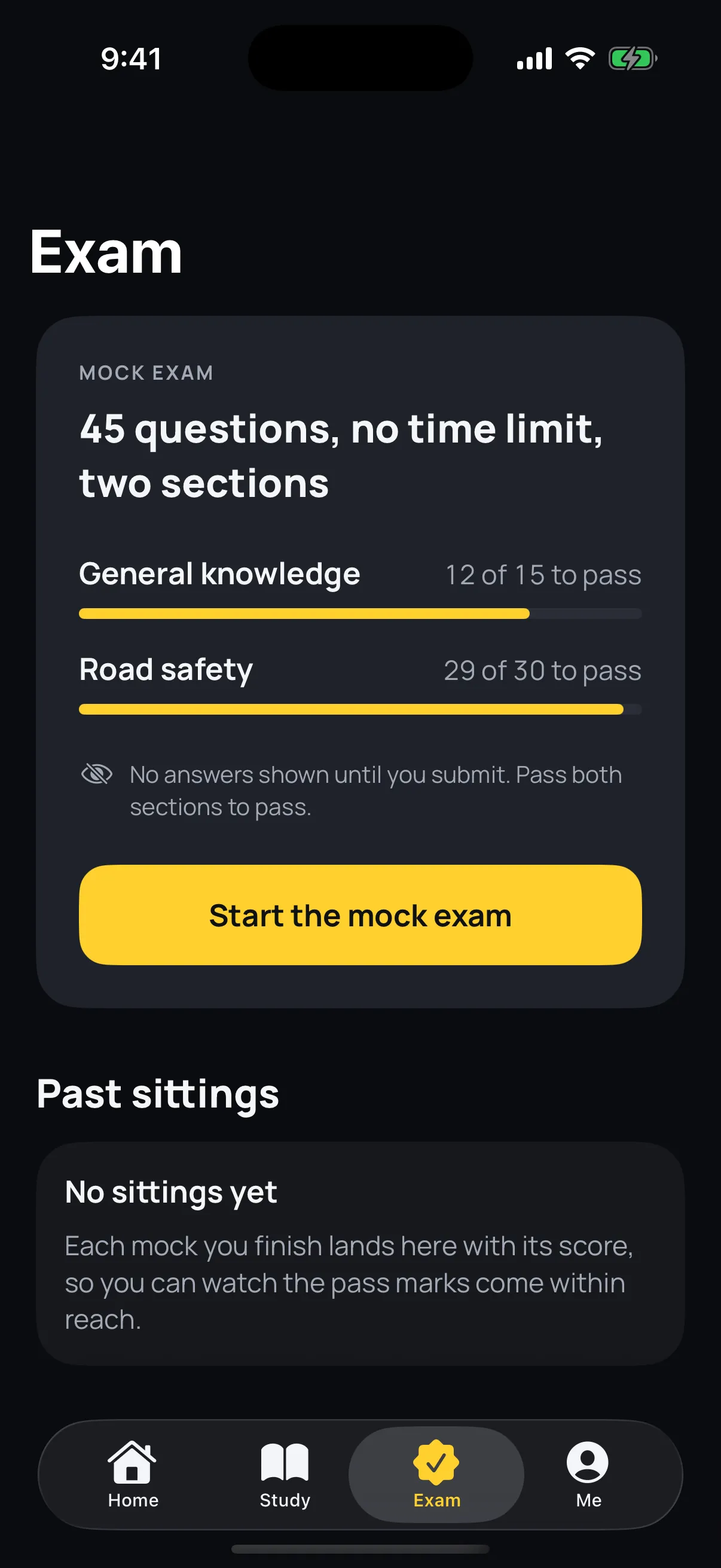
NSW Learner mock exam screen: 45 questions, no time limit, two sections with their pass marks
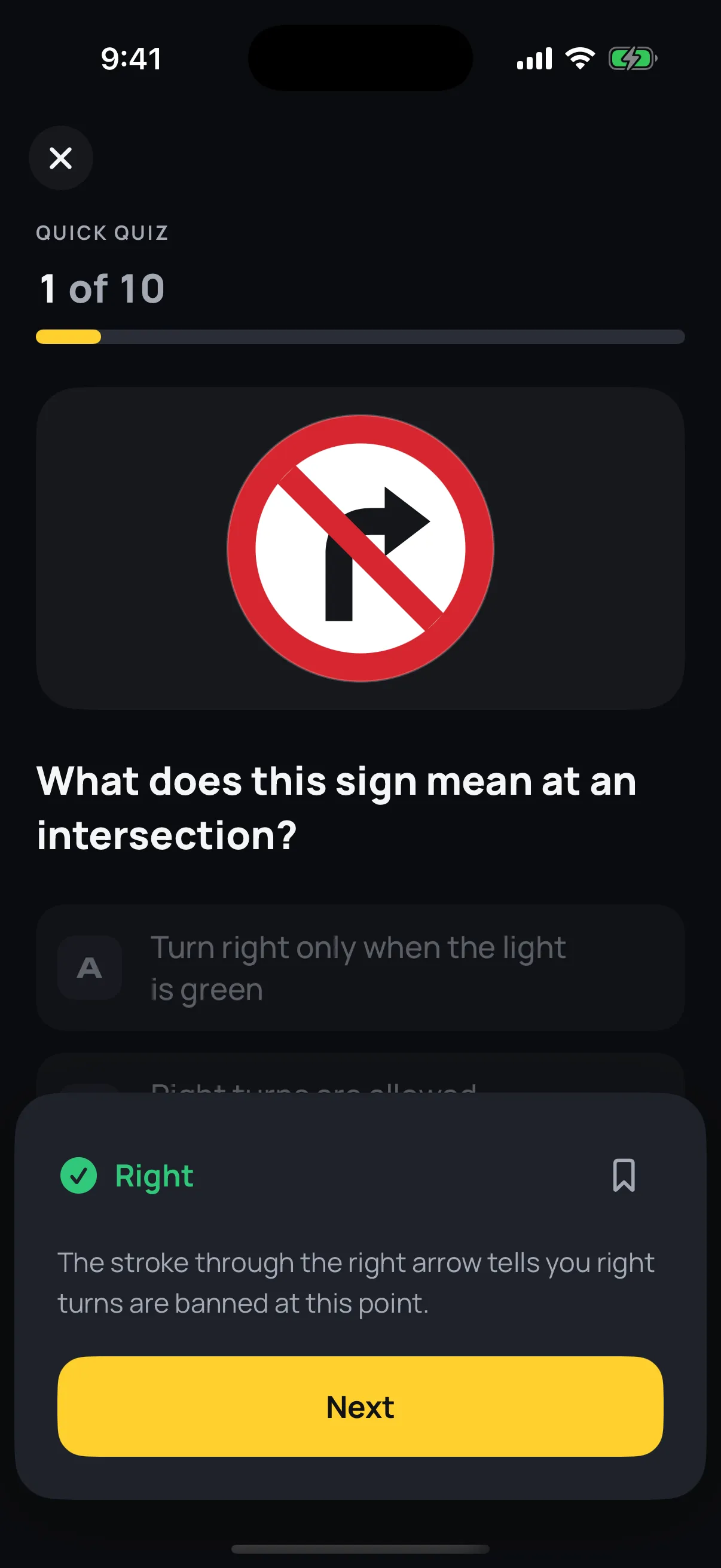
A practice question in NSW Learner answered correctly, with the explanation card
LP

Your L plate turns green when you would pass

NSW Learner is the practice app behind this site. Short lessons for every topic, drills that bring back what you got wrong, and a mock exam in the test's layout. It reads your recent scores and tells you honestly when you are ready.

  • Free one full mock exam, and the speed limits and traffic signs and signals topics with their lessons, drills and 179 questions
  • Pro all nineteen topics, all 1,177 questions and unlimited mock exams, one-time purchase, no subscription, no ads
  • Private no account, works offline, your progress stays on your phone

Independent study app. Not affiliated with Transport for NSW or Service NSW.