NSW LearnerNSW DKT practice
Get NSW Learner free

Practise for the NSW driver knowledge test

Road Safety

Safe driving habits for NSW learners

In the test. Safe driving questions rarely quote a rule. They describe a moment, like wheels slipping onto gravel or a side street hidden by a building, and ask for the safest habit or response.

Quick answer

What is stopping distance made up of?

Your stopping distance has two parts: the distance covered while you react, and the distance covered while you brake. Reaction distance is how far you travel before your foot reaches the brake, and it grows when you are distracted or slow to respond. At 60 km/h a car covers about 17 metres each second, so a 1.5 second reaction uses about 25 metres before braking even starts.

The short version

  • Set your seat, head restraint and mirrors before every drive
  • A head check over your shoulder is your last look before pulling out
  • At 60 km/h about 17 metres go by each second before you brake
  • Wheels on the gravel: ease off, slow down, steer back gently
  • Never answer an aggressive driver; let them go

Set up before you drive

A few seconds of adjustment gives you full control and a clear view.

  • Set the seat so you reach the pedals with your knees a little bent and the wheel without stretching.
  • Adjust the head restraint and mirrors as well, especially in a car someone else drove last.
  • Angle each side mirror so it shows mainly the road behind, with only a thin edge of your own car in view.
  • A mirror filled with your own door hides the lane beside you, so angle it out.
Pulling out from the kerb

Plenty can change between walking up to the car and moving off.

  • Check your mirrors first, then signal.
  • Mirrors leave a blind spot beside and behind the car that they cannot show.
  • A head check over your shoulder is the final thing you do before you pull out.
  • That last look is what saves a cyclist, car or person you had not noticed.

Scanning and hidden hazards

Many crashes come from seeing something too late, so keep your eyes busy.

  • Scan far ahead, to both sides and through every mirror, every few seconds.
  • Look left and right before entering any intersection, even on green.
  • Where a building, hedge or row of parked cars hides a side street, slow down and be ready to give way.
  • Beside parked cars, watch for doors opening, people stepping out and right indicators flashing.
  • Near a crest on a narrow road, keep left and slow down, because oncoming traffic can be hidden over the top.
  • Stay out of other drivers' blind spots and out of tight packs, so you always have room to escape.

Speed, space and stopping distance

The faster you go, the more road slips by before you can even react.

  • Total stopping distance adds the ground covered while you react to the ground covered while you brake.
  • At 60 km/h you travel about 17 metres a second, before braking begins.
  • A slow or distracted response stretches the reaction distance.
  • Crash energy rises much faster than speed, so a few km/h over the limit makes a crash more likely and far more severe.
  • Rear-end crashes mostly come from following too closely, and cars that run off a bend are usually going too fast for it.

When something goes wrong

In an emergency, smooth control beats sudden moves.

  • Wheels off the edge onto gravel: ease off the accelerator, let the car slow, then steer back on gently.
  • Oncoming car in your lane: brake, move left, and use your horn and headlights. Swerving right is risky, as the other driver may correct back to their own side.
  • Reverse only as far as you need and only when it is safe. Missed a shop on a busy road? Go round the block instead.
  • If a pedestrian steps out against the lights, you must still do everything you can to avoid them.

Hard braking or a sharp steer on a loose gravel edge can spin the car or roll it.

Attitude and building experience

Safe driving is as much a mindset as a skill.

  • You are responsible for your own safety and for everyone else around you.
  • Most crashes come from driver choices, not bad luck.
  • Cut off or tailgated? Stay calm: do not react, gesture or chase, and let the other driver pass when safe.
  • Begin on quiet roads by day, then build up to busy traffic, motorways, rain and night.
  • Make your first night drives on streets you know well, so the dark is the only new thing to handle.

Try this

Worked examples to think through

Picture the situation, decide what you would do, then open the answer.

1Try this

Driving at 60 km/h, you see a child dash onto the road 20 metres ahead. Why is stopping in time so unlikely?

Show the answer

In the second or so before your foot hits the brake, the car travels around 17 metres, and braking then needs more road on top of that. That is why speed and space matter so much near children.

2Try this

At 80 km/h your left wheels slip off the bitumen onto the gravel shoulder. What should you do?

Show the answer

Lift off the accelerator, hold the wheel firmly and let the car lose speed, then ease it back onto the road once it is safe. Sharp braking or a sudden steer can spin or roll the car.

Practise it

Three safe driving habits questions to try

Real questions from the 50 in the NSW Learner bank for this topic, three options each like the test. Pick one to see the answer, the reason and the rule.

Question 1 of 3 Road Safety

Your left side mirror shows half of your own car door. What should you do before driving off?

Right.Not quite. The answer is C.

A mirror full of your own car hides the lane beside you. Turn it out until you see mostly road.

Source: Safe driving practice

Question 2 of 3 Road Safety

At a corner, a house built right up to the footpath hides the side street from you. Why take extra care?

Right.Not quite. The answer is C.

When a building blocks your view, slow down and be ready to give way, because a vehicle or person may appear without warning.

Source: Safe driving practice

Question 3 of 3 Road Safety

At 60 km/h your reaction to a hazard takes 1.5 seconds. About how far do you travel before braking?

Right.Not quite. The answer is A.

At about 17 metres a second, one and a half seconds of reaction time means about 25 metres before the brakes even start working.

Source: Safe driving practice

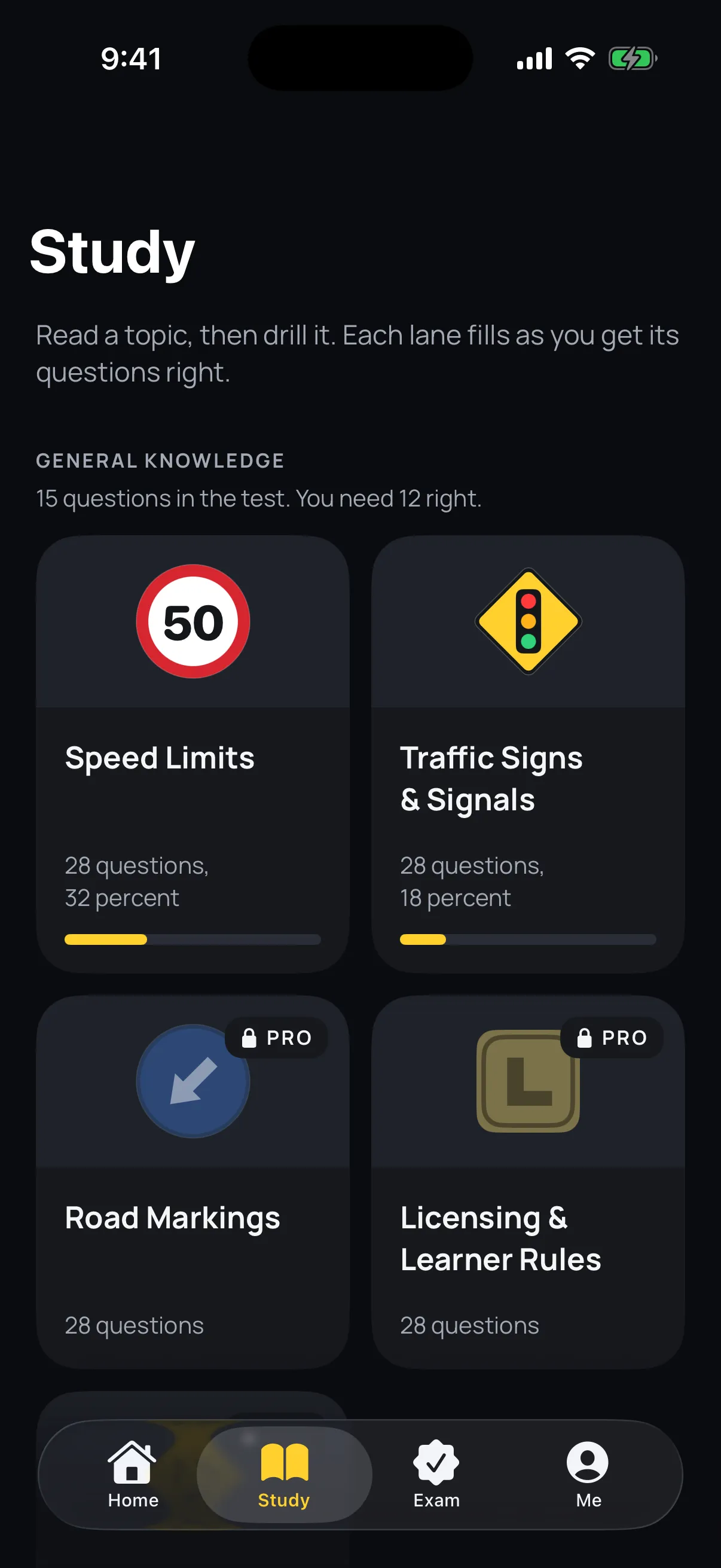
The NSW Learner Study tab with topic tiles, each with its drawn sign and a lane showing progress

Practise this topic in the app

Drill safe driving habits until it is automatic

In NSW Learner this topic has its own lesson and a drill of 50 questions. Questions you miss come back sooner, the lane on the tile fills as you get them right, and the mock exam mixes it in with everything else in the test's layout.

Common questions

How far does a car travel in one second at 60 km/h?
About 17 metres, all of it covered before your foot even reaches the brake.
What should you do if your wheels go off the edge of the road?
Ease off the accelerator, keep a firm grip and slow down gradually, then steer gently back on when it is safe. Do not brake hard or swerve.
What is the last check before pulling out from the kerb?
A head check over your shoulder, which covers the blind spot your mirrors miss.
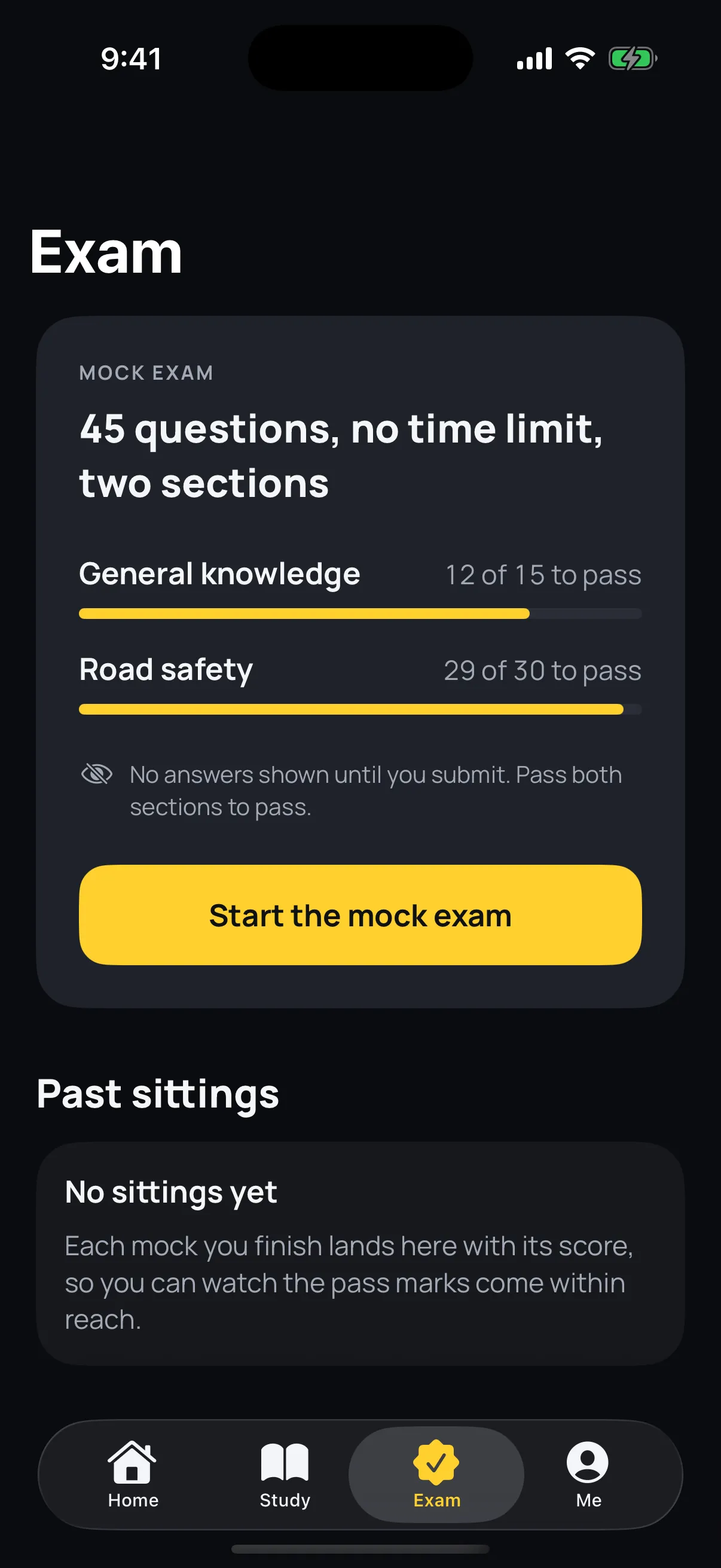
NSW Learner mock exam screen: 45 questions, no time limit, two sections with their pass marks
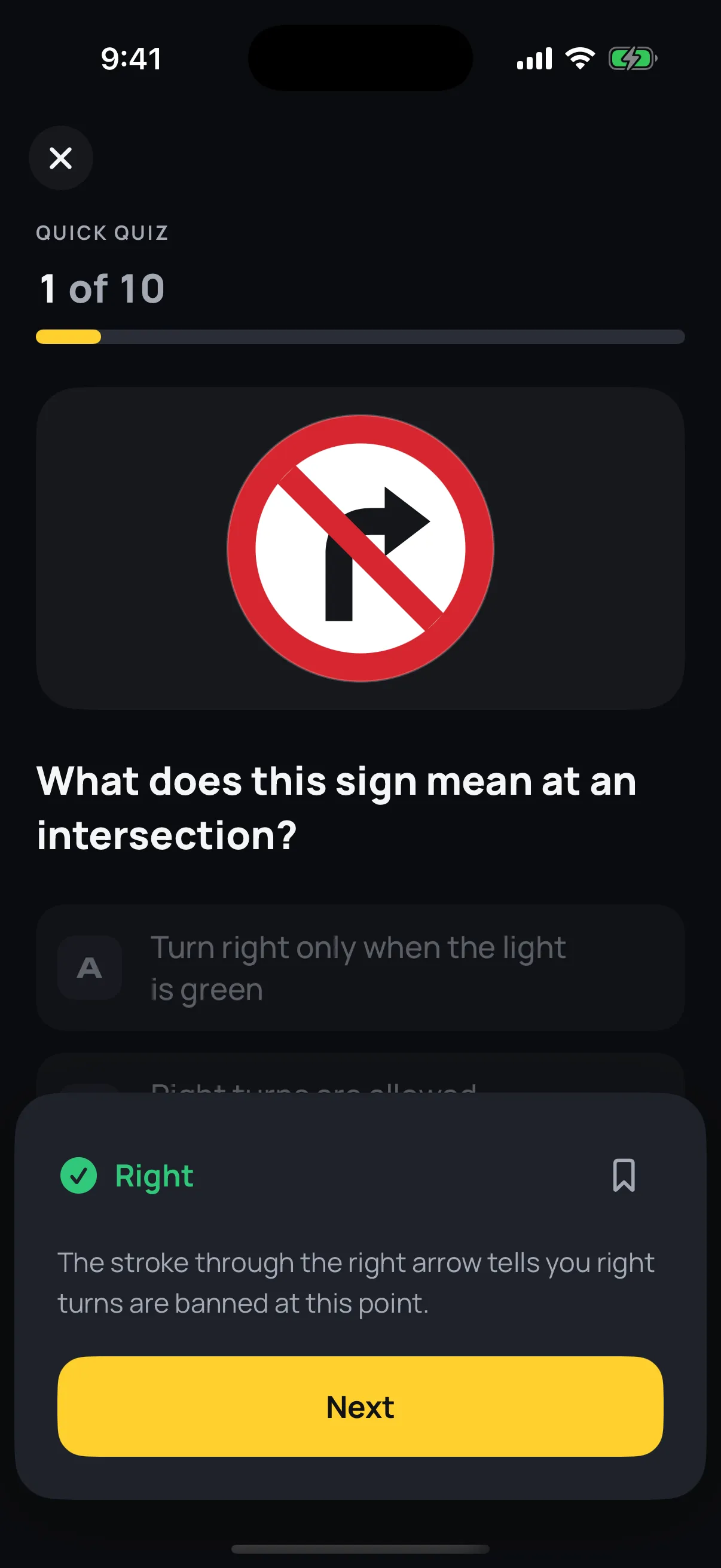
A practice question in NSW Learner answered correctly, with the explanation card
LP

Your L plate turns green when you would pass

NSW Learner is the practice app behind this site. Short lessons for every topic, drills that bring back what you got wrong, and a mock exam in the test's layout. It reads your recent scores and tells you honestly when you are ready.

  • Free one full mock exam, and the speed limits and traffic signs and signals topics with their lessons, drills and 179 questions
  • Pro all nineteen topics, all 1,177 questions and unlimited mock exams, one-time purchase, no subscription, no ads
  • Private no account, works offline, your progress stays on your phone

Independent study app. Not affiliated with Transport for NSW or Service NSW.