NSW LearnerNSW DKT practice
Get NSW Learner free

Practise for the NSW driver knowledge test

Road Safety

NSW parking rules and distances

In the test. Parking and stopping come under road safety on the DKT. Most questions turn on a sign, a painted line or a distance in metres, so the numbers are worth knowing cold.

P

Quick answer

How far from an intersection can you park in NSW?

Unless a sign allows it, you must not stop within 10 metres of an intersection without traffic lights, or within 20 metres of one with lights. Similar clear space applies at pedestrian crossings and bus stops, where you keep 20 metres back on the approach and 10 metres past them. Cars parked close to a corner block the view for everyone using it.

The short version

  • No stopping means not even a second at the kerb
  • No parking allows a 2 minute drop off with you within 3 metres
  • Stay 10 metres from an unsignalled intersection and 20 metres from lights
  • Keep 20 metres before and 10 metres after crossings and bus stops
  • A solid yellow kerb line rules out stopping

No stopping, no parking and time limits

Three kinds of sign cover most kerbs, and they mean very different things.

  • No stopping: the car may not halt there for any reason short of an emergency, passenger drop offs included.
  • No parking: a stop of 2 minutes or less is fine for dropping off or collecting people or goods, provided you stay within 3 metres of the car.
  • 2P, 1P and similar: the number is the limit in hours, so 2P from 10 am means leaving by midday.
  • Days and times on a sign limit when it applies. A 2P Mon to Fri sign does not apply on a Sunday.

Think of no stopping as zero seconds, and no parking as two minutes with you close by.
Distances to learn

Where no sign says otherwise, the rules keep clear space around places people need to see or reach.

  • Intersection without lights: 10 metres. With lights: 20 metres.
  • Pedestrian or children's crossing: 20 metres before, 10 metres after.
  • Bus stop sign: 20 metres before, 10 metres after.
  • Railway level crossing: 20 metres from the nearest rail, on either side.
  • Public postbox: 3 metres, except for a quick drop off or pick up.
  • Fire hydrant: 1 metre.

Places you must not stop

Some spots are off limits however briefly you plan to stay, with only narrow exceptions.

  • Along a continuous yellow edge line.
  • On a footpath, a nature strip or a median strip unless a sign allows it, on a traffic island, or across a driveway.
  • Beside a parked car, which is double parking.
  • In a bus zone, or in a clearway during its signed hours, where cars can be towed. A broken yellow line along the kerb marks a clearway, and its CLEARWAY sign gives the times when the kerb must stay empty.
  • In a taxi zone while its sign is in force, unless the car you are driving is a taxi.
  • On a crest or bend beyond built-up areas, where drivers coming up behind may not see you in time.
  • Anywhere on a motorway, other than the emergency stopping lane when you have an emergency or breakdown.

Parking the right way

Where you may park, how you park matters too.

  • On a two-way street, line up parallel with the left kerb, close to it and pointing the same way as the traffic.
  • Keep 1 metre or more from the parked cars ahead and behind, and at least 3 metres from a continuous centre line, or from double centre lines, so traffic can pass.
  • Angle park only where a sign or bay markings show it, at the angle they give. With neither, park parallel to the kerb.
  • In marked bays, put the whole car inside one bay.
  • Disability spaces are for vehicles displaying a valid mobility parking permit.
  • Loading zones are for loading or unloading goods, for a short time only.

Leaving your car

A parked car can still cause a crash if you leave it carelessly.

  • Apply the parking brake, and in an automatic, shift into P.
  • Walking more than 3 metres from the car: engine off, key with you, and doors locked if no one is staying in it.
  • Before opening your door, check for cyclists and passing traffic. A door must never be opened, or left hanging open, where it could endanger or block another road user.
  • Facing downhill, turn the front wheels towards the kerb. Facing uphill, turn them away.

Opening a door into a passing cyclist is a common cause of serious injury, so look behind every time.

Try this

Worked examples to think through

Picture the situation, decide what you would do, then open the answer.

1Try this

A friend needs dropping off at the station, and the only kerb free has a NO PARKING sign. Are you allowed to pull in?

Show the answer

Yes, for 2 minutes at most while they get out, provided you stay within 3 metres of the car. If the sign said NO STOPPING, you could not pull in at all (rules 167 and 168).

2Try this

There is a space 8 metres from a corner. The intersection has no traffic lights, and no sign covers the spot. Can you take it?

Show the answer

No. At an intersection without lights or signs you must keep 10 metres or more clear, so other drivers can see and turn (rule 170).

Practise it

Three parking rules questions to try

Real questions from the 69 in the NSW Learner bank for this topic, three options each like the test. Pick one to see the answer, the reason and the rule.

Question 1 of 3 Road Safety

10 m10 m

How close to an intersection without traffic lights may you park, if no sign says otherwise?

Right.Not quite. The answer is A.

Parked cars near a corner block the view, so you must keep at least 10 metres from an intersection without lights.

Source: Road Rules 2014 (NSW) rule 170

Question 2 of 3 Road Safety

P

What may you do where this sign applies?

Right.Not quite. The answer is B.

A no parking area lets you make a quick stop of two minutes or less as long as you stay close to your vehicle.

Source: Road Rules 2014 (NSW) rule 168

Question 3 of 3 Road Safety

Outside a built-up area, why must you not stop on a crest or curve?

Right.Not quite. The answer is A.

Crests and bends hide stopped vehicles, so the rules keep them clear unless drivers can see you from far enough back.

Source: Road Rules 2014 (NSW) rule 193

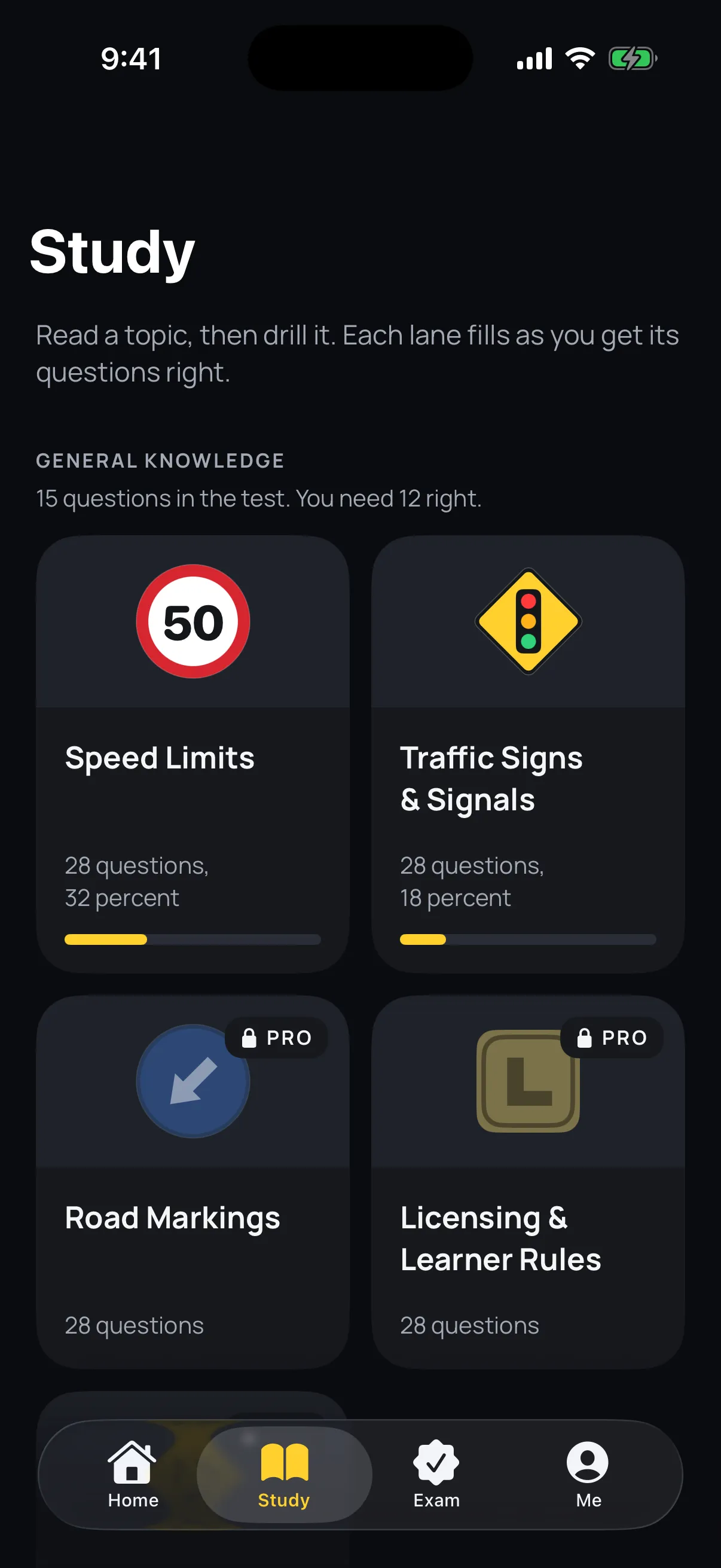
The NSW Learner Study tab with topic tiles, each with its drawn sign and a lane showing progress

Practise this topic in the app

Drill parking rules until it is automatic

In NSW Learner this topic has its own lesson and a drill of 69 questions. Questions you miss come back sooner, the lane on the tile fills as you get them right, and the mock exam mixes it in with everything else in the test's layout.

Common questions

What is the difference between no stopping and no parking in NSW?
No stopping rules out any stop except in an emergency. No parking allows a drop off or pick up lasting 2 minutes or less, if you stay within 3 metres.
How far from a bus stop can you park in NSW?
You must not stop within 20 metres before a bus stop sign or 10 metres after it, unless a sign allows it.
How close can you park to a fire hydrant?
No closer than 1 metre.
Which way do you turn your wheels when parking downhill?
Towards the kerb, so the wheels catch it if the car starts to roll.
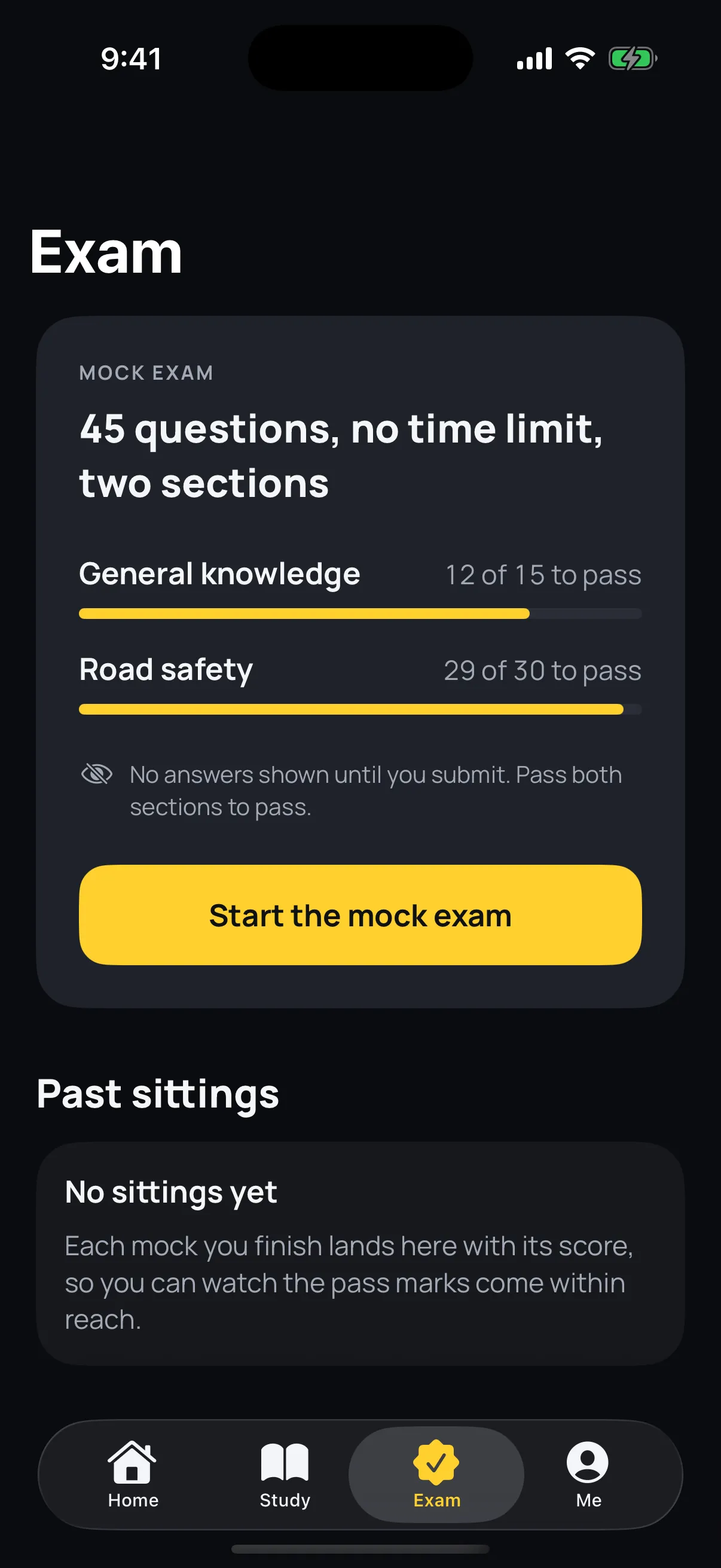
NSW Learner mock exam screen: 45 questions, no time limit, two sections with their pass marks
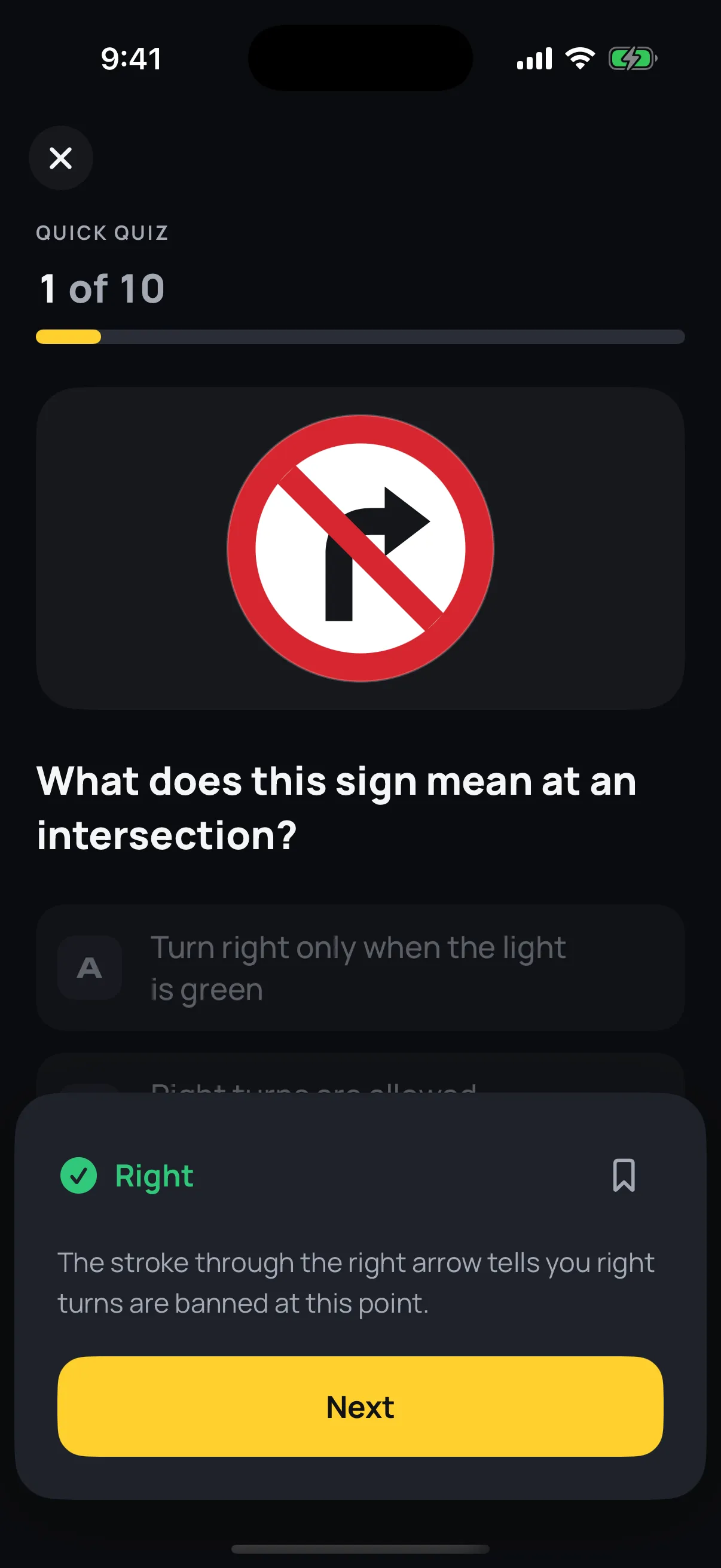
A practice question in NSW Learner answered correctly, with the explanation card
LP

Your L plate turns green when you would pass

NSW Learner is the practice app behind this site. Short lessons for every topic, drills that bring back what you got wrong, and a mock exam in the test's layout. It reads your recent scores and tells you honestly when you are ready.

  • Free one full mock exam, and the speed limits and traffic signs and signals topics with their lessons, drills and 179 questions
  • Pro all nineteen topics, all 1,177 questions and unlimited mock exams, one-time purchase, no subscription, no ads
  • Private no account, works offline, your progress stays on your phone

Independent study app. Not affiliated with Transport for NSW or Service NSW.