NSW LearnerNSW DKT practice
Get NSW Learner free

Practise for the NSW driver knowledge test

General Knowledge

NSW road signs and traffic lights explained

In the test. On the DKT, sign questions belong to general knowledge and usually show a sign on screen, then ask what it requires of you. Traffic light questions focus on steady yellow, red and flashing yellow arrows, dead signals and bus lights.

Quick answer

What do the different shapes of road signs mean in NSW?

Shape tells you the type of sign before you can read it. A red octagon is a stop sign, so you stop fully every time. A downward pointing triangle means give way. A round sign with a red ring bans the move it shows, such as a U-turn. A yellow diamond warns you of a hazard ahead, like a bend, a crossing or wildlife.

The short version

  • A stop sign needs a full stop every time, then you give way
  • A give way sign means slow, look, and stop only if you must
  • A red ring bans whatever move is pictured inside it
  • Yellow diamonds give early warning of a hazard
  • On a steady yellow light, stop unless it is unsafe to do so
  • B and T lights are for buses and trams, never cars

Stop and give way signs

These two signs decide who goes first at a great many NSW intersections, and they are not interchangeable.

  • The red octagon STOP sign means a complete stop at the line, every single time.
  • After stopping, give way to any vehicle or person you would otherwise cross or hit.
  • The give way sign is a triangle with its point down, a red border and black lettering.
  • At a give way sign you slow and look, and you only stop if someone needs to go first.
  • A stop ahead or give way ahead sign warns you that one of these is coming up.
  • LEFT TURN ON RED PERMITTED AFTER STOPPING: halt at the red first, then make the left turn once it is safe, letting traffic and people on foot go before you.
  • A give way triangle ringed by circling arrows marks a roundabout, so everyone already going round has priority over you.

An empty road does not excuse you at a stop sign. The full stop is required even when nothing is coming.
Red ring signs: what you must not do

A round sign with a red ring sets a ban, and the picture inside tells you which move is off limits.

  • No entry: do not drive past the sign into that road, often because it runs one way towards you.
  • No U-turn: U-turns are banned where the sign applies.
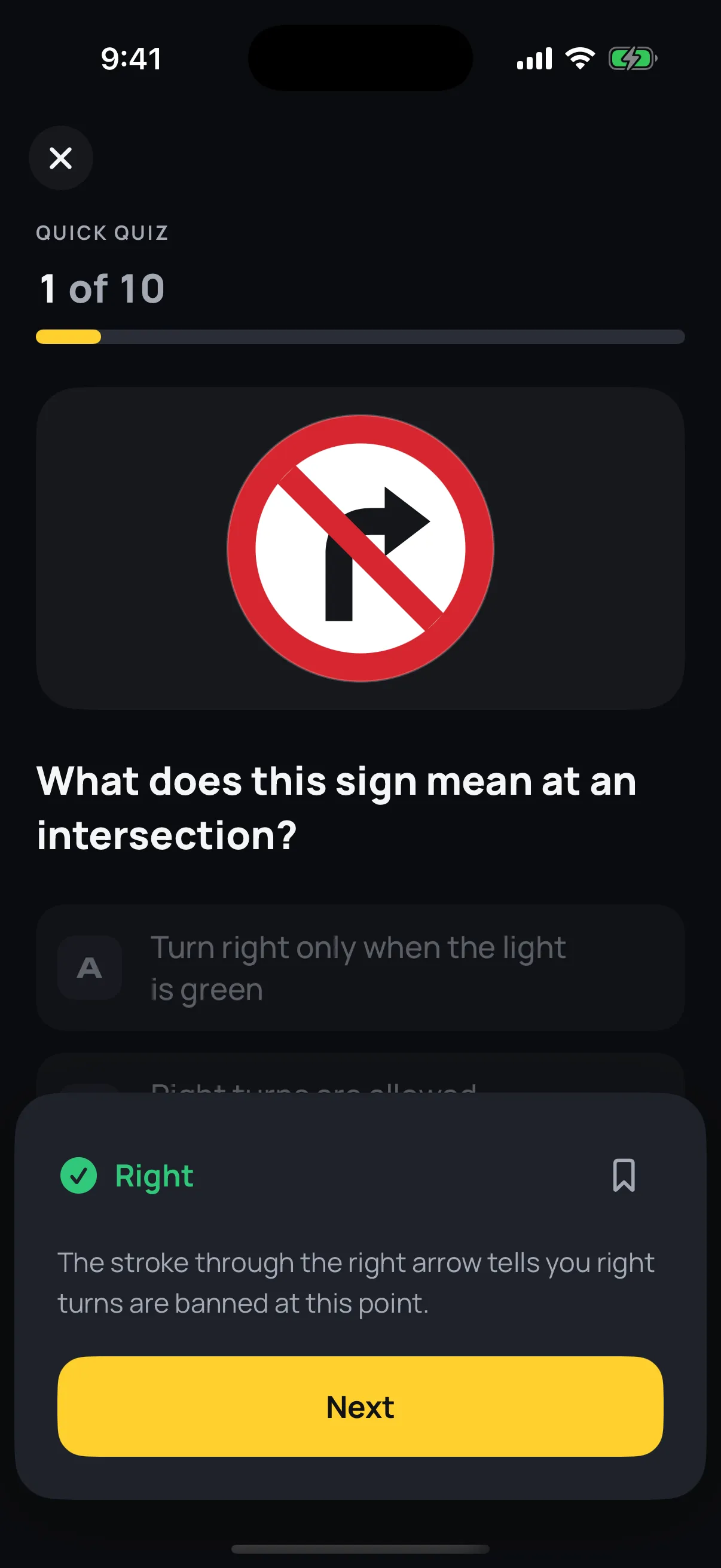
  • No left turn and no right turn: a red stroke through the arrow cancels that turn.
  • These bans hold on an empty road too. Only times printed on the sign itself can switch one off.
  • A speed limit sign is also a number in a red circle, and it sets the maximum from there on.

Signs for direction and lanes

Some signs ban nothing. They point you in the only direction you are allowed to take, or say who a lane is for.

  • Keep left: drive around the island or obstruction on its left side.
  • One way: the arrow shows the single direction every vehicle on that road must travel.
  • TWO WAY: traffic ahead runs in both directions, often where a one way street finishes, so keep left and expect cars coming at you.
  • RIGHT LANE MUST TURN RIGHT: once you are in that lane, the coming intersection means a right turn for you, whatever you had planned, so settle on your lane early.
  • A turn arrow above the word ONLY: no vehicle there may go any direction but the one shown.
  • KEEP LEFT UNLESS OVERTAKING: the right lane is for passing, turning right or getting around an obstruction, and nothing else.
  • Lane signs such as bus lane and transit lane set who may use a lane during its hours. A transit number counts everyone on board, driver included, and motorbikes may use any transit lane.

Yellow warning signs

Yellow diamond signs do not create a rule of their own. They tell you what is coming so you can slow down early.

  • Animals: kangaroos, cattle or other stock may be on the road, most often around dawn and dusk. A plate underneath, such as NEXT 30 km, says how far the warning runs, so keep watching for all of it.
  • Road shape: a sharp bend, a hairpin that doubles back on itself, a snaking arrow for a run of bends, a narrowing road, or a steep descent, where you change to a lower gear before you start down.
  • What you cannot see: CREST means a hilltop hides the road beyond, so slow down and keep left. DIP means a sudden hollow in the surface, so slow before it.
  • Room running out: a narrow bridge barely fits two vehicles side by side, and when a divided road ends, oncoming traffic shares your road. Slow down and keep left for both. A road divides sign means a median is about to split the two directions.
  • Junctions: a T-intersection, a crossroad where traffic can join or cross from either side, a side road that vehicles may pull out of, a roundabout, or traffic lights hidden by a hill or curve.
  • Who may be on the road: children crossing, people walking where there is no marked crossing, bike riders, trucks entering or crossing, plus a road hump or a slippery surface.
  • A yellow speed plate under a bend sign is the safe speed for that curve in good conditions. In the wet, take it slower still.

Quick sort for the test: eight red sides stop you, a point-down triangle puts you second, a red ring forbids, and yellow means heads up.

Roadworks signs

Roadwork signs are rectangles rather than diamonds, and every one of them is a cue to slow down and be ready to stop.

  • Workers ahead: ease off and be ready to stop, even when nobody is in sight. Machines and bends can hide people.
  • Traffic controller ahead: someone holding a STOP and SLOW bat is in charge of the traffic, and you do exactly what they show.
  • A controller's directions beat the usual rules wherever they stand, including at an intersection where the lights are out.
  • Lane ends: move into the lane that carries on, giving way to vehicles already travelling in it.
  • STOP HERE ON RED SIGNAL: at portable traffic lights, this sign marks where you wait while the light is red.

Railway crossing signs

Level crossing signs tell you how much checking the tracks need from you, from a look both ways to a full stop.

  • A yellow diamond with railway tracks warns of a level crossing ahead. Some have no lights or gates, so the checking is up to you.
  • A diamond showing a crossbuck with two lamps means the crossing ahead has flashing signals, so slow down and be ready to stop.
  • Crossbuck above a stop sign: a full stop on every approach, a check in both directions, and across only when the line is clear of trains.
  • Crossbuck above a give way sign: ease right off, check each way along the line and let any train have the crossing.
  • Crossbuck with red lights: flashing means you wait, and you keep waiting until any gates have gone up.

Traffic light rules

Traffic signals look simple, but DKT questions test the moments in between colours.

  • Red: stop behind the stop line and stay there until the light turns green.
  • Steady yellow: stop, unless you are so close that braking would be unsafe. If it changes as you are already entering the intersection, carry on through.
  • Green circle: go straight, left or right when safe, giving way to people crossing as you turn and to oncoming traffic as you turn right. Check the intersection is clear first, in case someone runs their red.
  • Green arrow: you may only go the way it points, and while the round light is red, every other direction keeps waiting.
  • Red arrow: no turning that way until it goes off, even at an hour when the road is deserted.
  • Flashing yellow arrow: turn only once oncoming traffic and pedestrians are clear.
  • Lights dark or flashing yellow: obey any stop or give way sign, such as the stop sign with three black circles kept for this, and with none, use the normal intersection rules.

White B and T signals only release buses and trams. A car facing a red light keeps waiting.

Try this

Worked examples to think through

Picture the situation, decide what you would do, then open the answer.

1Try this

In the middle of the night, with not a car in sight, you sit in the right turn lane. The green light for going straight is on, but your right arrow shows red. Can you go?

Show the answer

No. Stay behind the line until the red arrow switches off or turns green. The arrow controls your turn at every hour, whether or not anything is coming.

2Try this

You approach lights that are flashing yellow, and the corner on your side has a stop sign. How do you handle it?

Show the answer

Exactly as a stop sign: pull up at the line, then give way. Once the signals stop working the signs are in charge, and with no signs you fall back on the normal give way rules (rule 63).

3Try this

You want to go straight and are sitting in the right of two lanes when a RIGHT LANE MUST TURN RIGHT sign goes past. There is no room to move left. What now?

Show the answer

Make the right turn and work your way back from there. The sign binds every vehicle in that lane, including you (rule 89).

4Try this

Past a traffic controller ahead sign, the controller faces you with the STOP side of the bat, though you can see nothing in the way. What do you do?

Show the answer

Stop and wait until the bat turns to SLOW or you are waved through. The controller can see hazards beyond your view (rule 101).

Practise it

Three traffic signs and signals questions to try

Real questions from the 110 in the NSW Learner bank for this topic, three options each like the test. Pick one to see the answer, the reason and the rule.

Question 1 of 3 General Knowledge

STOP

You reach this sign at an intersection. What must you do?

Right.Not quite. The answer is B.

A stop sign means a full stop every time, then you give way to traffic before you continue.

Source: Road Rules 2014 (NSW) rule 67

Question 2 of 3 General Knowledge

The light changes from green to steady yellow as you approach. What should you do?

Right.Not quite. The answer is C.

A steady yellow means stop unless you are so close that stopping would be unsafe.

Source: Road Rules 2014 (NSW) rule 57

Question 3 of 3 General Knowledge

B

Your light is red, but a white B light is showing beside it. What should you do in a car?

Right.Not quite. The answer is A.

Special B lights let buses move ahead of other traffic, so the red light still applies to you.

Source: Road Rules 2014 (NSW) rule 56

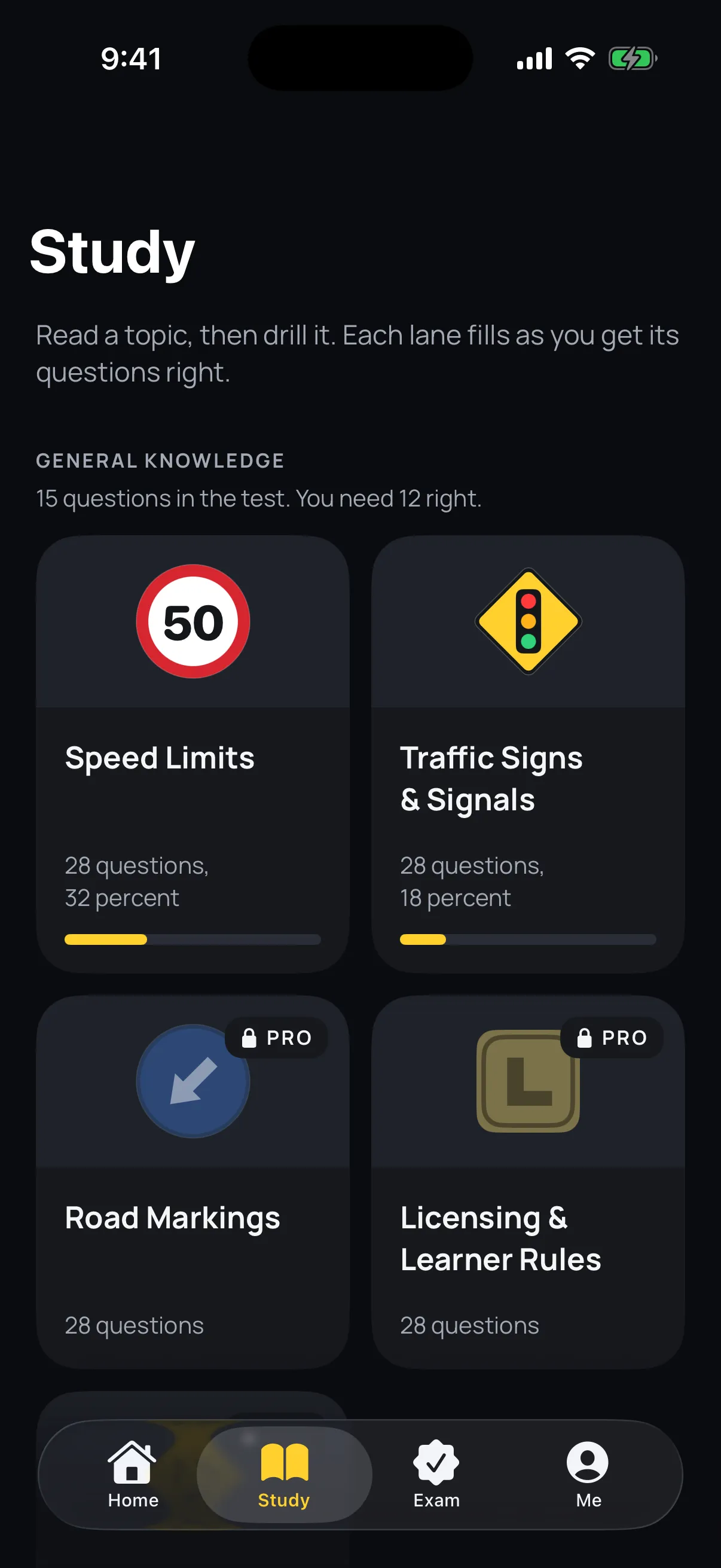
The NSW Learner Study tab with topic tiles, each with its drawn sign and a lane showing progress

Practise this topic in the app

Drill traffic signs and signals until it is automatic

In NSW Learner this topic has 2 lessons and a drill of 110 questions. Questions you miss come back sooner, the lane on the tile fills as you get them right, and the mock exam mixes it in with everything else in the test's layout.

Common questions

What is the difference between a stop sign and a give way sign?
At a stop sign you must come to a full stop every time. At a give way sign you only stop if there is traffic or a pedestrian you need to let go first.
What colour is the give way sign in NSW?
It is a triangle pointing down with a red border and black lettering.
Can I go through a yellow light in NSW?
Only if you are so close to the line that stopping would be unsafe. Otherwise a steady yellow means stop.
What should I do if the traffic lights are not working?
Follow any stop or give way signs at the intersection. If there are none, use the normal give way rules for an intersection without signals.
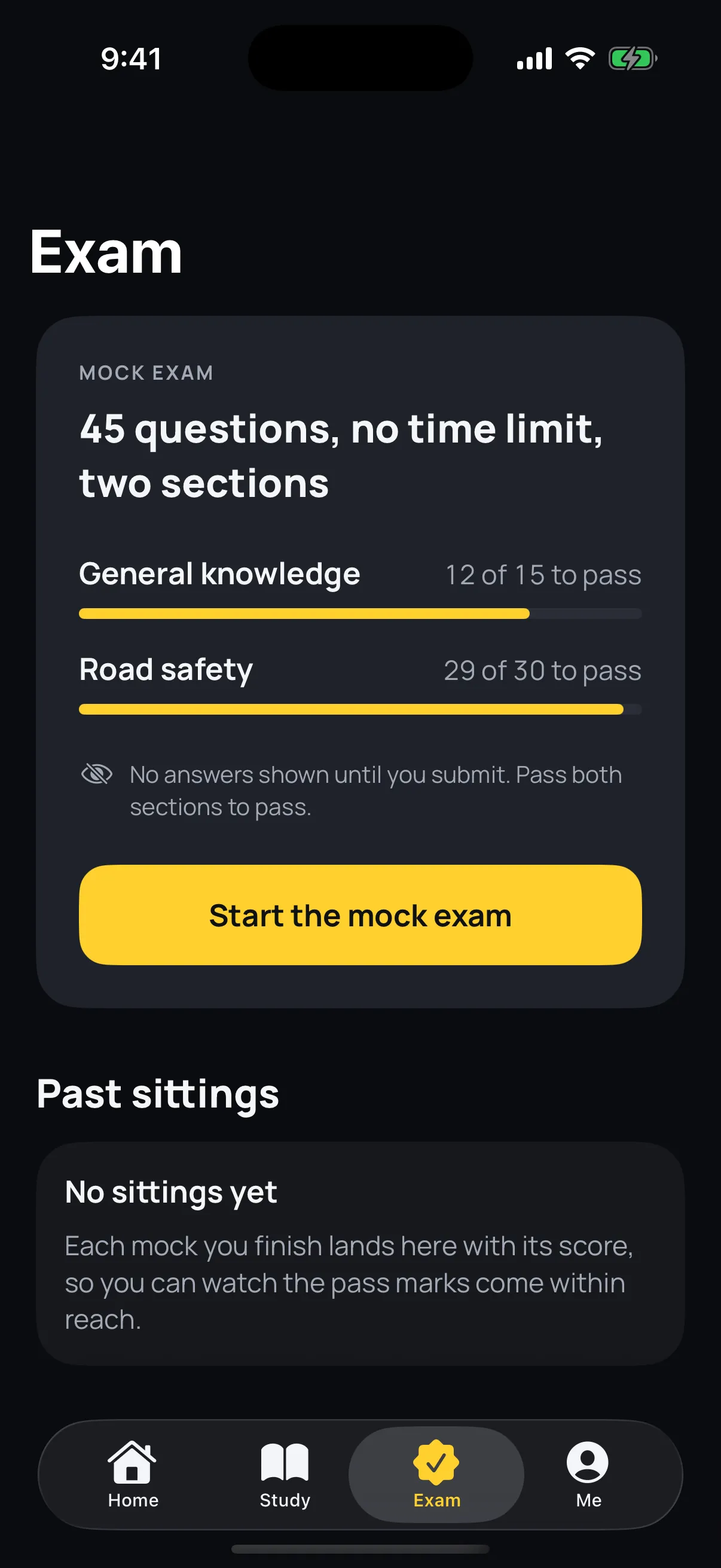
NSW Learner mock exam screen: 45 questions, no time limit, two sections with their pass marks
A practice question in NSW Learner answered correctly, with the explanation card
LP

Your L plate turns green when you would pass

NSW Learner is the practice app behind this site. Short lessons for every topic, drills that bring back what you got wrong, and a mock exam in the test's layout. It reads your recent scores and tells you honestly when you are ready.

  • Free one full mock exam, and the speed limits and traffic signs and signals topics with their lessons, drills and 179 questions
  • Pro all nineteen topics, all 1,177 questions and unlimited mock exams, one-time purchase, no subscription, no ads
  • Private no account, works offline, your progress stays on your phone

Independent study app. Not affiliated with Transport for NSW or Service NSW.